Comparative Model of Life Cycle Cost for PA6, PA66 and Recycled Nylon 1
Apr 23, 2026
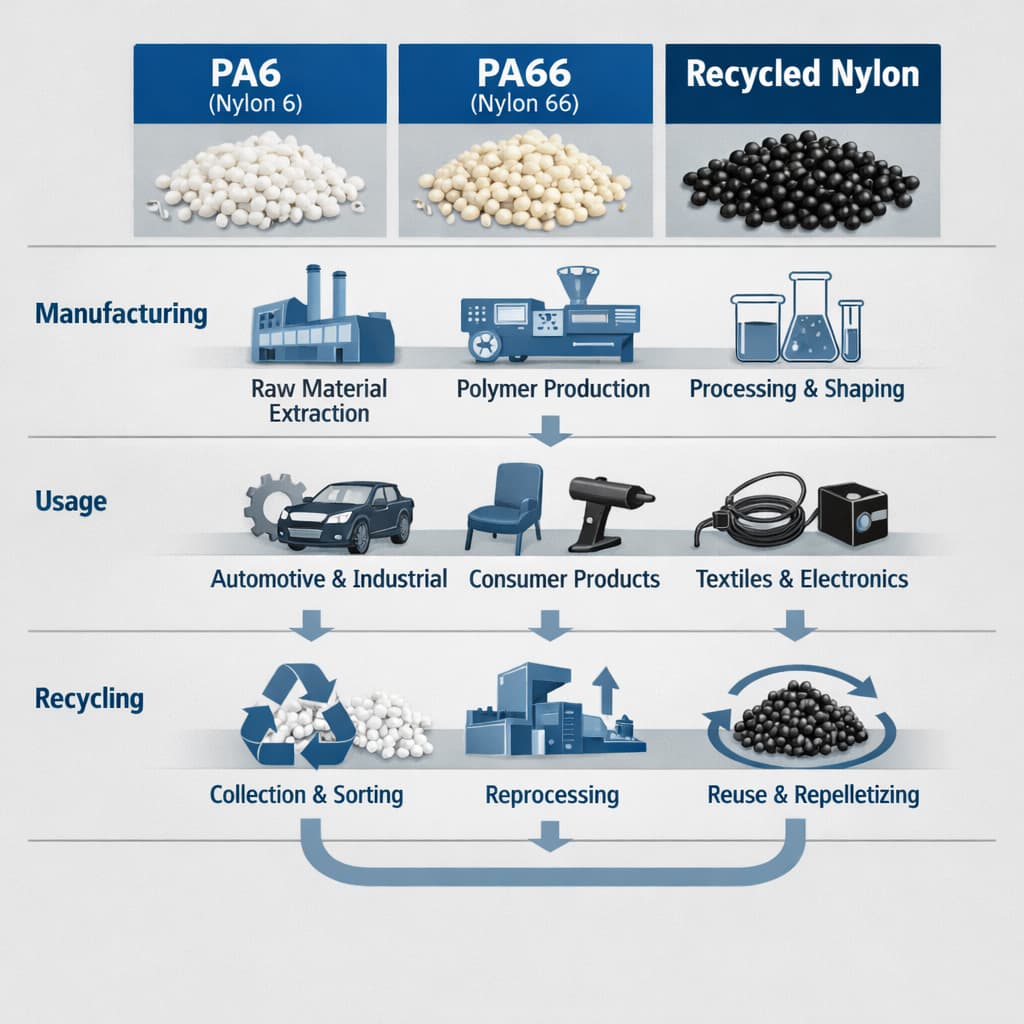
In engineering material selection, many companies still rely heavily on the unit price of raw materials as the primary indicator of cost advantage. However, in real manufacturing environments, the cost of a polymer material cannot be evaluated solely based on its purchase price. For polyamide materials in particular, the total cost is influenced by multiple factors including processing efficiency, mold wear, cycle time, product durability, and end-of-life recycling potential.
Because of these variables, engineering teams in industries such as electric vehicles, home appliances and industrial equipment are increasingly using lifecycle cost models when comparing PA6, PA66 and recycled nylon materials.
In practical production scenarios, the most visible difference between PA6 and PA66 appears during processing and thermal performance. PA6 generally exhibits a lower melting temperature and better melt flow characteristics. These properties make it suitable for complex geometries or thin-wall injection molded components. In high-volume production lines for electronic housings or appliance components, PA6 often allows lower injection pressure and faster cavity filling. As a result, the injection molding cycle can be shortened, improving overall production throughput.
PA66, on the other hand, provides higher heat resistance and superior mechanical rigidity. Components operating near electric drive systems or exposed to continuous thermal loads typically benefit from these properties. In structural components that must maintain dimensional stability under temperatures approaching 120°C, PA66 often demonstrates better long-term reliability.
From a molecular structure perspective, the difference between PA6 and PA66 can be explained by their hydrogen bonding arrangement and crystallinity behavior. PA66 tends to form a more regular molecular structure with stronger hydrogen bonding interactions. This typically results in higher crystallinity, which contributes to improved stiffness, higher heat deflection temperature and better resistance to long-term thermal aging.
However, this structural advantage also introduces certain trade-offs. PA66 requires higher processing temperatures and typically consumes more energy during injection molding. In large-scale manufacturing environments, these differences influence machine energy consumption, cooling time and mold cycle duration.
Read More