Is Higher Glass Fiber Content Always Better? An Analysis of Mold Life Issues Caused by Over-Reinforcement Section1
Jan 29, 2026
In engineering plastic selection, glass fiber reinforced nylon is often equated with higher strength, lower deformation, and improved reliability. During early project stages, design teams frequently assume that increasing glass fiber content is a straightforward solution: if GF30 is insufficient, then GF40 or even higher grades are considered. However, real manufacturing experience increasingly shows that excessive reinforcement introduces underestimated systemic risks, particularly related to mold wear, processing instability, and long-term production cost escalation.
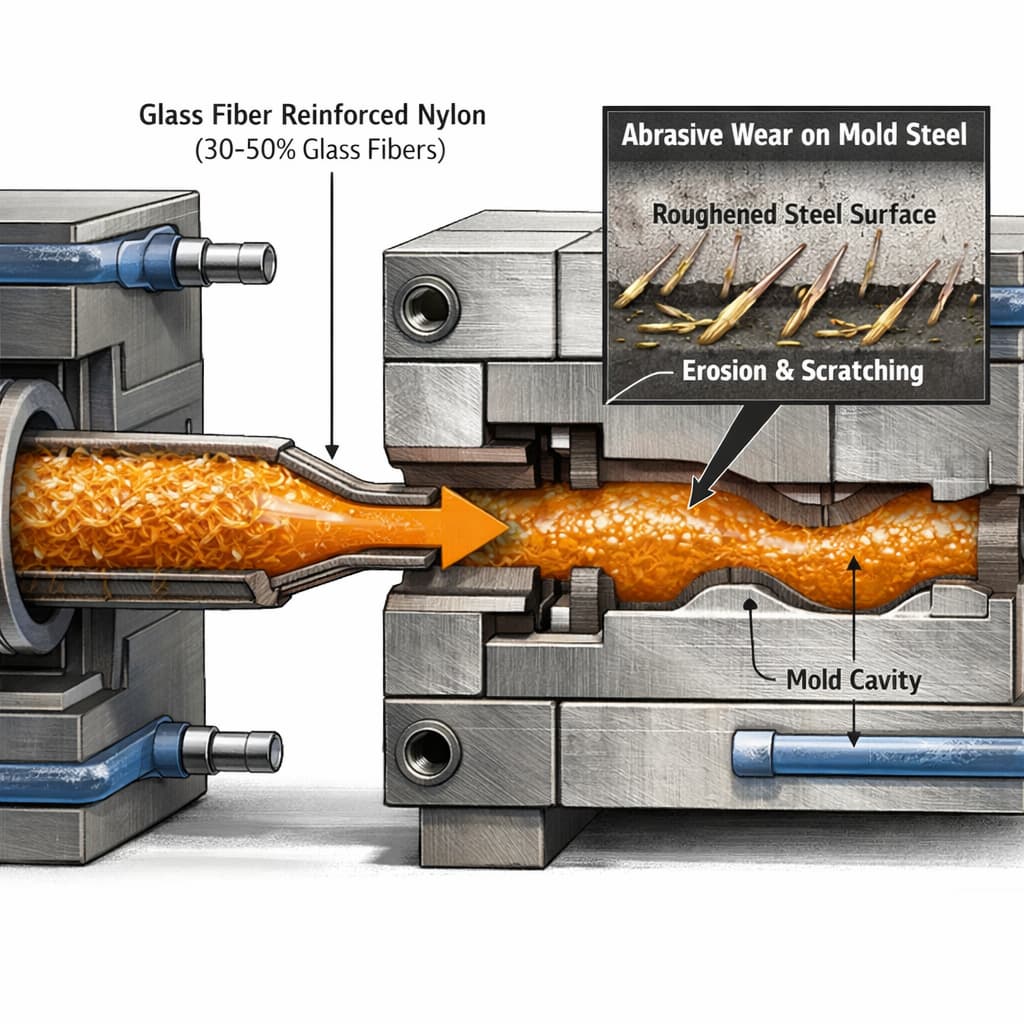
In an automotive electronic housing project, PA66 GF30 was initially selected. Due to deformation risks under high-temperature vibration, the glass fiber content was increased to GF40. While flexural modulus improved by approximately 25% and thermal expansion was further reduced, severe mold wear appeared within six months of mass production. Gate and cavity surfaces degraded rapidly, leading to surface defects and premature mold refurbishment, ultimately delaying delivery schedules.
From a material mechanics perspective, glass fiber does not provide linear benefits beyond certain thresholds. As fiber content exceeds 30–40%, fiber-to-fiber interaction increases significantly. During high-shear injection molding, insufficiently resin-coated fiber ends repeatedly contact mold steel surfaces, producing a micro-cutting wear mechanism. This wear accumulates progressively and concentrates in gates, runners, and thin-wall regions.
Read More