
What Are You Looking For?

A practical example involves an automotive connector housing made from PA66 GF30. During scaling, reducing mold temperature from 90°C to 70°C improved cycle time but reduced impact resistance by ~15%, leading to failure. Restoring the original mold temperature resolved the issue, highlighting the dependence of performance on process conditions.
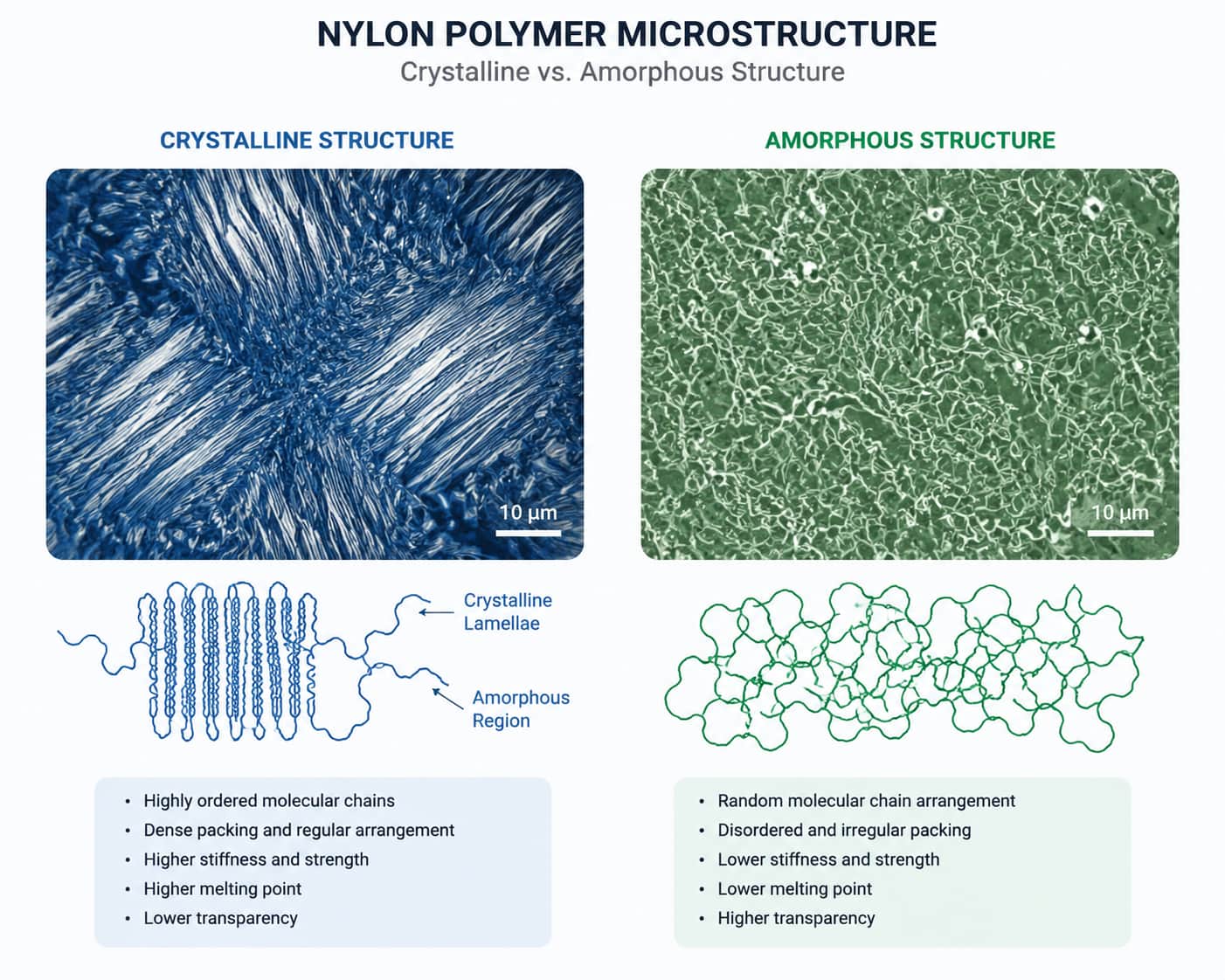
Crystallization kinetics of polyamide directly link cooling rate to mechanical properties. Faster cooling increases stiffness but reduces toughness. Maintaining this balance is essential but often compromised in high-throughput production.
Data confirms these trends: impact strength can vary over 20% with moisture fluctuations, and flexural modulus shifts by 10–15% with mold temperature changes. These variations are significant enough to affect product reliability.
Ultimately, performance optimization is not about selecting a better material, but about controlling the processing system. Engineers should prioritize drying standards, mold temperature windows, and shear limits to ensure consistency.