What Are You Looking For?

Multifunctional Composite Modified Nylon: Integrated Solution Combining Flame Retardant, Conductive and Thermal Conductive Properties 02
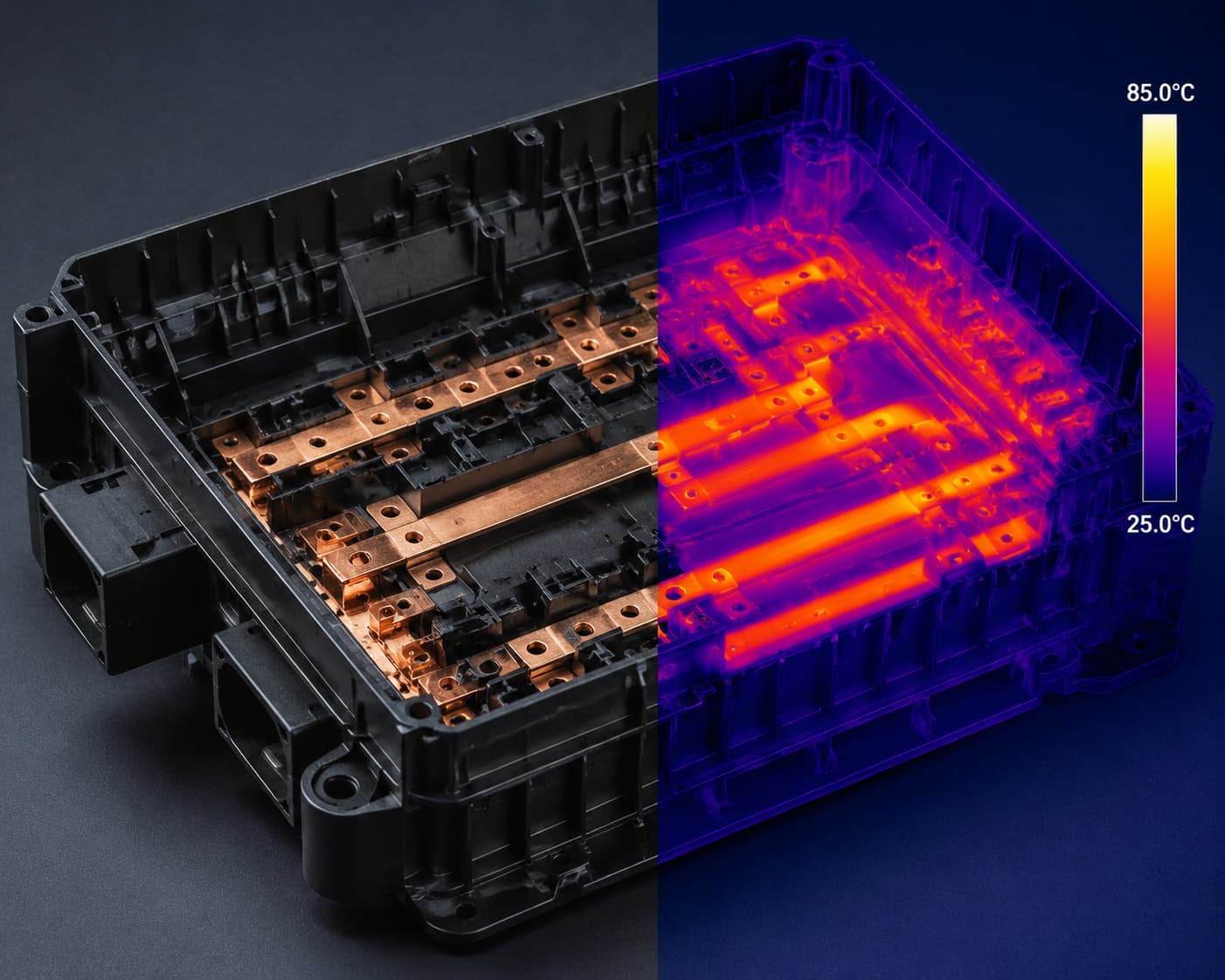
In practical industrial validation and extended environmental stress testing, this tri-functional compound modified nylon has demonstrated compelling performance stability. In critical assemblies within electric vehicle high-voltage propulsion architectures—such as high-voltage junction boxes and on-board charger (OBC) housings—the material consistently achieves a UL 94 V-0 flame rating (even at a thin wall thickness of 0.8mm) while maintaining predictable isotropic or anisotropic thermal conductivity and a tightly controlled volume resistivity spanning the anti-static to conductive range. Following 1,000 hours of rigorous Damp Heat testing (85°C / 85% relative humidity), the degradation rates of its dielectric strength, flame retardancy, and thermal conductivity remain within minimal margins, showing no signs of filler migration or surface resistivity degradation. Furthermore, in actual injection molding trials, optimized microscopic phase structures grant the compound excellent melt flow behavior and low mold abrasion characteristics. This ensures that complex, precision parts with non-uniform wall thicknesses and dense metal inserts can be molded in a single cycle without surface fiber floating. The resulting increase in production yield, paired with a significant reduction in overall system component count, yields substantial cost amortizations. This paradigm of materials engineering, verified by rigorous empirical data and field scenarios, offers global industrial clients unprecedented design freedom, liberating engineers from traditional material-stacking compromises to realize true lightweight, high-safety system integration.