What Are You Looking For?

Multifunctional Composite Modified Nylon: Integrated Solution Combining Flame Retardant, Conductive and Thermal Conductive Properties 01
In today’s high-end manufacturing, new energy vehicles, 5G communications, and rail transit sectors, engineering designers regularly face a punishing material selection dilemma. As equipment integration scales up, electronic components operate at high speeds within extremely compact spaces. This not only causes severe internal heat accumulation but also sharply increases the risks of electromagnetic interference and high-voltage breakdown. Historically, engineers addressed these segregated functional requirements by deploying multiple single-function modified plastics: flame-retardant nylon around power modules, thermally conductive plastics for heat sinks, and anti-static or conductive materials for sensitive housing components. However, when these extreme operating conditions converge onto a single micro-component, traditional multi-piece assembly methods significantly inflate product volume and weight. More critically, interfacial thermal resistance and mismatched coefficients of thermal expansion between discrete material layers inevitably lead to delamination or mechanical failure under long-term vibration and continuous thermal cycling. This structural complexity, coupled with fragmented component sourcing and climbing post-maintenance overheads, represents a severe systemic bottleneck for B2B manufacturers striving to improve equipment reliability and reduce total ownership costs.
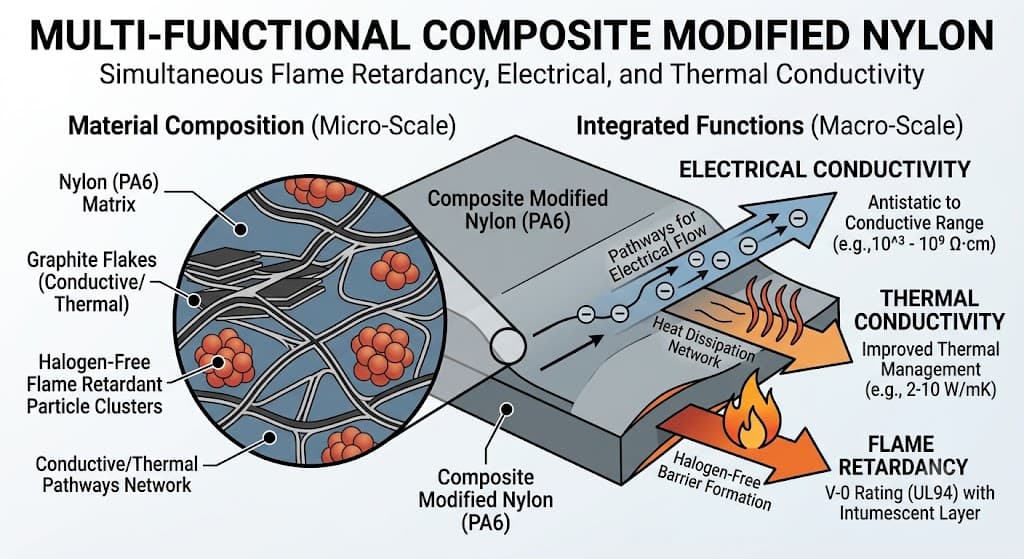
Addressing these multi-dimensional operational stresses demands a multi-functional compound modified nylon capable of seamlessly integrating flame retardancy, electrical conductivity, and thermal conductivity into a single polymer matrix. From the perspective of polymer physics and formulation engineering, this integration cannot be achieved by merely dumping multiple functional additives into a twin-screw extruder. Flame retardants, conductive fillers (such as carbon nanotubes, graphene, or specialized carbon black), and thermally conductive fillers (such as boron nitride, silicon carbide, or aluminum oxide) exhibit drastically different geometric profiles, surface energies, and dispersion behaviors within polyamide matrices like PA66, PA6, or long-chain nylons. Without precise phase morphology control, the high loading levels required for thermal conductivity will destroy the material's impact toughness and melt processability. Concurrently, carbon-based conductive fillers can exhibit antagonistic effects with certain flame-retardant packages, degrading the flame rating or causing electrical drift at elevated temperatures. Consequently, a truly integrated solution relies on engineering a "functional synergistic network." Utilizing advanced asymmetric blending techniques and targeted surface chemical modification, conductive fibers and thermally conductive particles are steered to form co-continuous, interconnected microscopic pathways—analogous to high-speed networks within the nylon matrix. This architecture achieves stable electrostatic dissipation or EMI shielding at ultra-low conductive filler thresholds, ensures continuous pathways for rapid heat dissipation, and allows the polymer skeleton to cooperate with halogen-free flame retardants to form a dense, protective char layer upon thermal exposure, sealing out oxygen and mitigating heat propagation.