What Are You Looking For?

Ultimate Solution for Surface Roughness of Traditional PA12 Powder: Engineering Realization of Spheroidization Technology 02
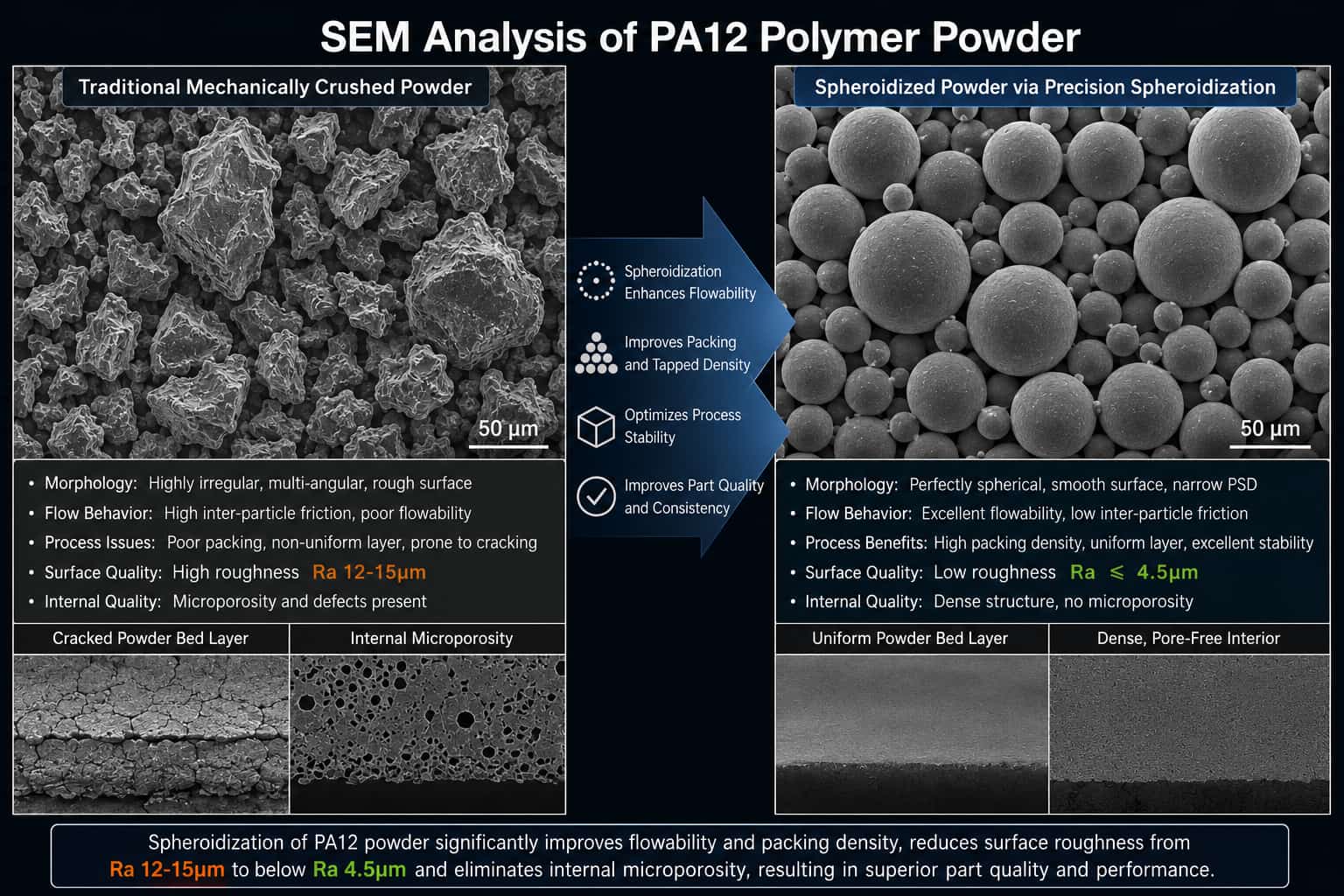
Eliminating this engineering pain point requires abandoning the physical destruction of material geometric boundaries caused by mechanical crushing, and turning instead to high-precision spheroidization technology to reshape the microscopic morphology of PA12 particles. From the essence of material physics and structural design, a perfect sphere possesses the absolute minimum specific surface area in three-dimensional space. This implies that when PA12 powder is reshaped into smooth, miniature spherical particles, the contact area between particles is minimized to the extreme, drastically weakening the Van der Waals forces and electrostatic attraction originally induced by sharp multi-angular features.
The concrete engineering realization of spheroidization technology typically relies on high-shear thermo-mechanical reshaping or thermal plasma melting and expansion processes. In this precisely controlled technological workflow, irregular traditional PA12 powder is introduced into a specific thermophysical field. Under a strictly regulated temperature window, typically managed precisely between the melting point and the initial softening point of the material, the surface layer of the powder particles undergoes instantaneous micron-level semi-melting. At this juncture, surface tension in fluid mechanics begins to dominate the reshaping process, forcing the molten liquid phase to spontaneously contract toward the center. This action perfectly envelops and blunts the original sharp corners and torn jagged edges, which subsequently condense and crystallize into highly spherical, smooth microspheres.
This microscopic reshaping yields revolutionary physical performance dividends for the 3D printing process. First, the high-sphericity powder demonstrates excellent fluidity, behaving closely to a liquid. Particles glide and arrange themselves smoothly ahead of the recoater roller like miniature ball bearings, completely eliminating powder bed cracking caused by blade dragging. Second, because spherical particles achieve geometric close packing—attaining an extremely high tapped density—the microscopic voids within the powder layer are compressed to the limit. Upon laser irradiation, the spherical powder exhibits highly uniform heat absorption behavior and thermal diffusivity. The drastically improved Melt Flow Rate (MFR) enables the surface tension under the liquidus line to prompt the molten droplets to spread out rapidly and evenly, quickly eliminating entrapped micro-gases before solidification. This not only significantly broadens the processing thermal window but fundamentally cuts off thermal stress concentration caused by particle anisotropy, resulting in printed structural components with surfaces as smooth and delicate as those produced by high-precision injection molds.
Through rigorous engineering validation involving 100,000 recoating cycles and continuous dynamic scanning across multiple batches, a series of precise physical indicators and experimental data have revealed the decisive impact of spheroidized PA12 powder on the engineering quality of macro products. Tested via standard fluid dynamics Hall flowmeters and dynamic angle of repose measurements, the overall flowability indicators of the PA12 powder reshaped through spheroidization improved by more than 35% compared to traditional mechanically crushed powder, with gravity flow velocity accelerating significantly. This means that on high-speed industrial production lines, material conveying and distribution become exceptionally stable.
In comparative SLS printing experiments with identical layer thickness (standard 0.12 mm), the surface roughness Ra value of components formed with traditional powder usually fluctuates between 12 and 15 microns, feeling distinctly rough and granular to the touch. Conversely, the surface roughness Ra value of components printed with spheroidized PA12 powder drops drastically to below 4.5 microns, presenting a refined matte texture. This immensely eliminates tedious, time-consuming post-processing steps such as sandblasting and vibratory polishing.
Even more encouraging data stems from deep mechanical property testing. When the formed components were sectioned and placed under a Scanning Electron Microscope (SEM) for micro-morphological observation of the fracture surfaces, lab technicians discovered that the microscopic porosity universally present in traditional powder components plummeted from the original 2.8% to less than 0.3%, reaching a nearly dense and defect-free state inside the material. In tensile strength and impact toughness tests conducted via mechanical tensile testers, thanks to the perfect fusion of isotropic spherical particles within the melt pool, the Z-axis (the direction vertical to the printing layer stacking), which traditionally represents a performance bottleneck in 3D printing, successfully broke the curse of "interlaminar delamination." Its overall Z-axis mechanical strength retention rate increased by nearly 25%, achieving a balanced leap in both tensile strength and elongation at break. This is not merely an improvement in surface physical appearance, but a comprehensive engineering technological leap that utilizes material microscopic geometric reshaping to empower high-end B2B manufacturing and realize the serial production of high-strength, high-toughness structural end-use parts.