What Are You Looking For?

Ultimate Solution for Surface Roughness of Traditional PA12 Powder: Engineering Realization of Spheroidization Technology 01
On the production lines of industrial-scale Selective Laser Sintering (SLS) and Powder Bed Fusion (PBF) additive manufacturing, the surface quality of high-precision engineering structural components has long been restricted by a fundamental material defect. Many enterprises discover a recurring "lunar surface" rough texture on the finished products when printing PA12 (Polyamide 12) nylon parts. This roughness not only directly destroys the cosmetic appearance of the components, making them unsuitable for direct use as end-use parts, but more critically, microscopic irregularities imply that stress concentration easily occurs within the material structure, leading to premature fatigue failure when components are subjected to alternating loads. This inherent deficiency in surface quality originates not from the laser power or scanning speed of the 3D printer, but from the traditional PA12 raw material powder utilized at the topmost industrial upstream.
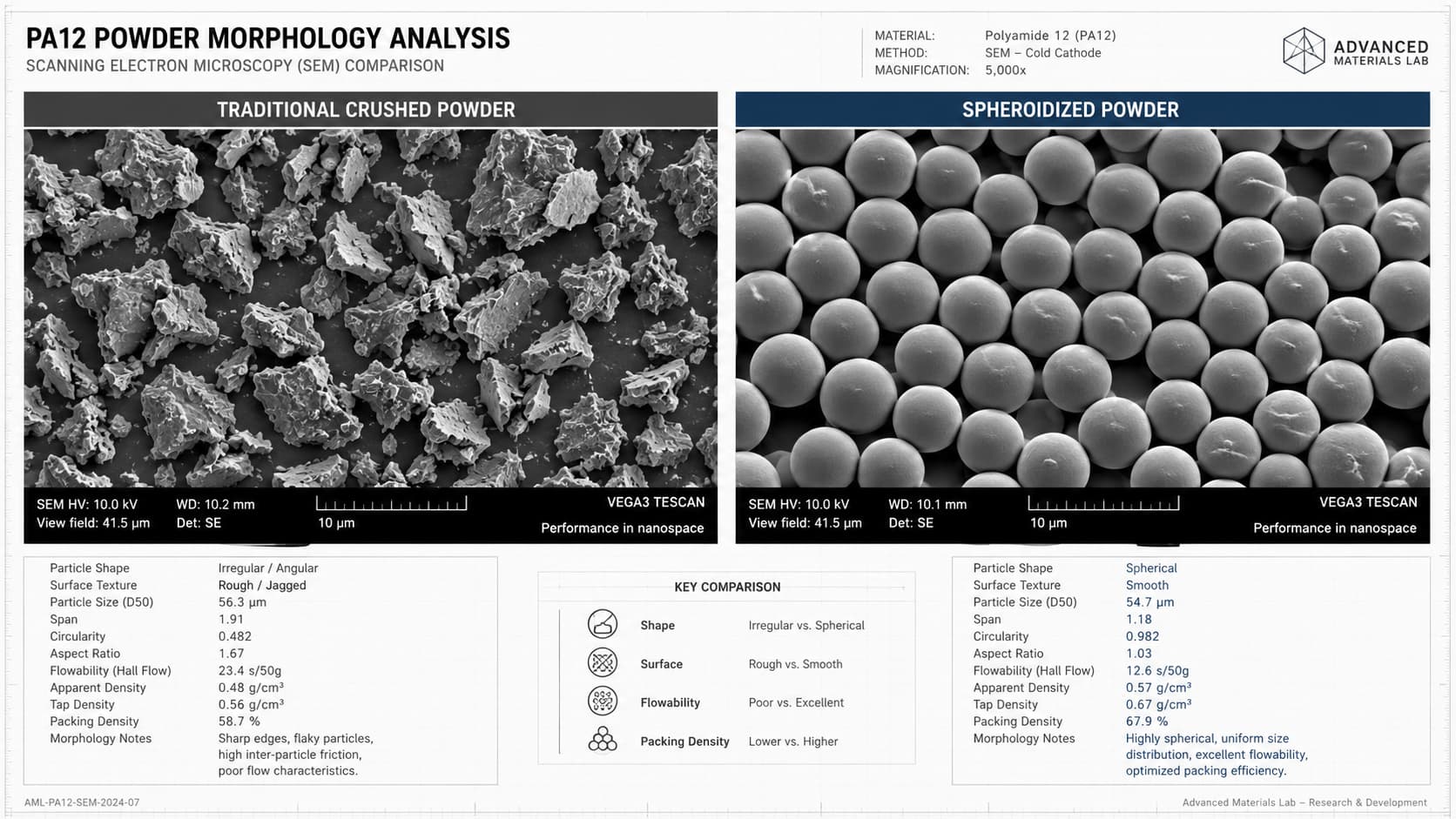
To understand this engineering pain point thoroughly, we must magnify our vision to the microscopic level of material particles. Currently, most cost-effective traditional PA12 powders available on the market are manufactured primarily via mechanical crushing methods, such as low-temperature cryogenic milling. This approach forcibly tears, blunts, and breaks bulk nylon raw materials into micron-sized powders using intense mechanical impact forces. Observed under a Scanning Electron Microscope (SEM), the geometric morphology of these traditional particles is highly irregular, displaying a massive amount of torn, flaky, elongated, and sharp multi-angular structures resembling jagged blades. It is precisely this extremely irregular microscopic morphology that acts as the primary culprit behind a series of subsequent disasters in the 3D printing process.
When such rough and variably shaped powder is loaded into the supply chamber of a printer and pushed across the build platform by a recoater blade or roller, derived engineering problems emerge immediately. From the perspective of fluid mechanics, when irregular particles come into contact with one another, the geometric interlocking forces and surface friction resistance between them increase exponentially. This is highly analogous to pouring a bag of sharp, angular broken bricks onto the ground; they cannot flow smoothly and easily lock into each other. During the recoating process, this poor flowability directly causes noticeable "microscopic drag tearing" as the blade pulls the powder, triggering surface cracking, furrowing, or even localized layer delamination in the powder bed.
Furthermore, these multi-angular particles cannot achieve close packing when piled together, leaving massive microscopic voids between particles, which results in an exceptionally low bulk density and tapped density of the powder bed. When a high-energy laser beam scans across such a powder bed filled with microscopic voids and density non-uniformity, the heat conduction within the powder becomes highly non-homogeneous. The laser energy cannot disperse uniformly at the initial instance, causing over-melting in certain zones while leaving powder trapped in interstitial voids insufficiently melted. The geometry of the melt pool fluctuates drastically under this severe thermal instability. As the liquid nylon condenses and solidifies under the influence of surface tension, the uneven thermal stress distribution caused by non-uniform powder deposition and particle anisotropy is permanently "inherited" and solidified into microscopic pores and inclusion defects within the component. On the macro surface, this ultimately manifests as a persistently high Ra value on the rough industrial skin.