What Are You Looking For?

Hidden Hazards of PA12 Powder Hygroscopicity: The Complete Chain from Printing Failure to Long-Term Performance Degradation 2
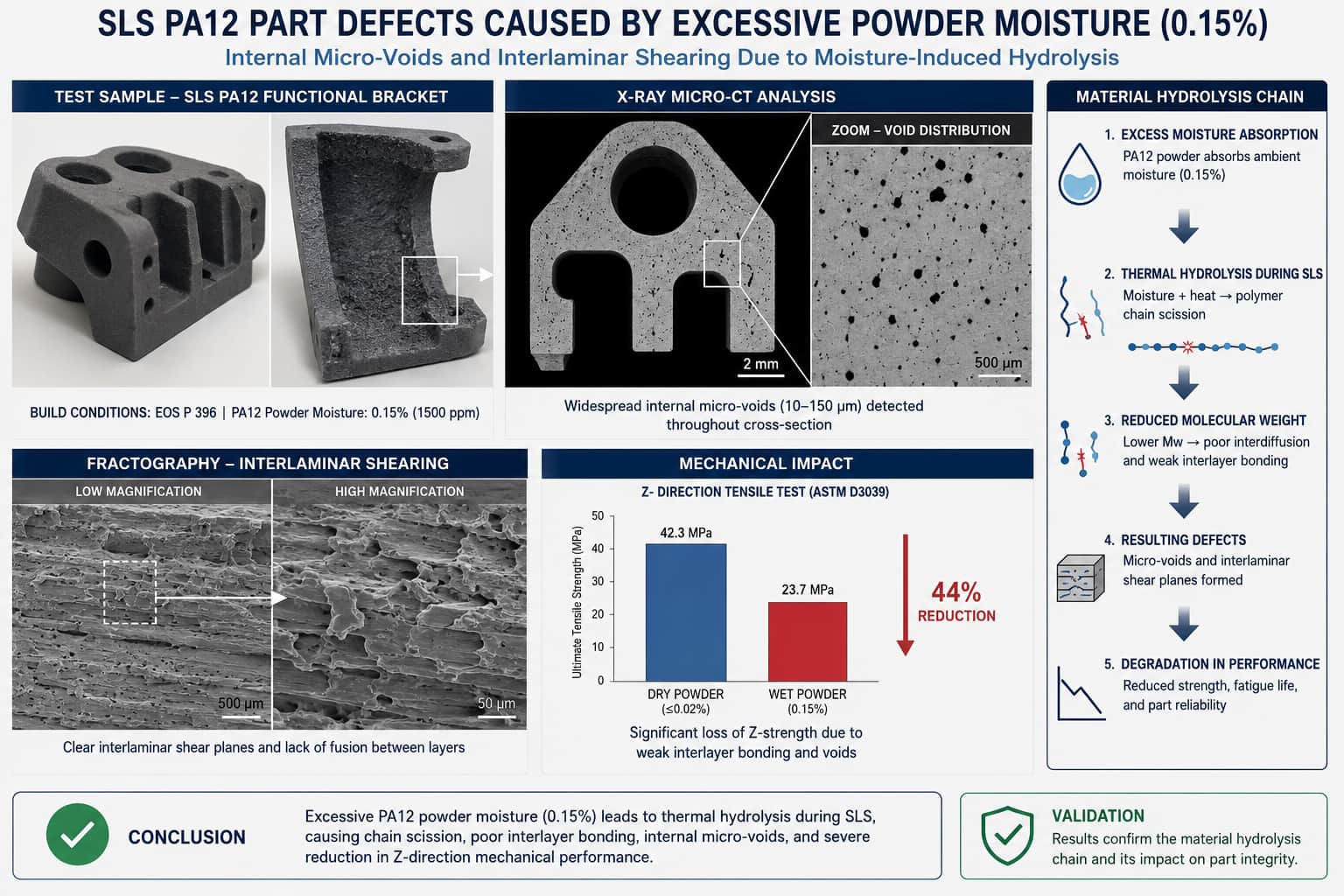
This micro-chemical process directly triggers anomalous fluctuations in the Melt Flow Index (MFI), reducing material viscosity and causing excessive melt pool fluidity, which in turn leads to bleeding edges and out-of-tolerance dimensions. A more far-reaching hazard is that the decrease in molecular weight locks in an "inherent defect" of the component, causing its creep resistance and fatigue life to exhibit a precipitous decline during subsequent long-term service. This is an unacceptable catastrophe for high-reliability application scenarios such as automotive structural components or aerospace ducting.
Extensive laboratory test data and long-term production experience validate the inevitability of this degradation chain. Experiments indicate that when the moisture content of PA12 powder exceeds 0.1%, the tensile strength of its molded parts typically decreases by 15% to 20%, and the elongation at break can plummet by more than 40%. Observing the fracture surface via high-magnification Scanning Electron Microscopy (SEM) reveals that components printed with dry powder exhibit clear ductile fracture characteristics, whereas those printed with hygroscopic powder are densely pitted with micro-voids, and cracks propagate rapidly along the edges of these pores, showing a typical highly brittle fracture mode. In a 1000-hour constant temperature and humidity aging test, the mechanical strength decay rate of components prepared from hygroscopic powder was nearly twice as fast as that of standard dry components. These data clearly demonstrate that moisture does not bring a temporary processing difficulty, but rather an irreversible material degradation.
Countering this hidden hazard requires technical enterprises to construct a full-link humidity control system spanning warehousing, storage, secondary blending, and pre-heating drying. Relying solely on empirical visual inspection to assess powder conditions can no longer meet the rigorous precision demands of modern industrial manufacturing; introducing high-precision trace moisture analyzers for quantitative detection is an indispensable line of defense. Meanwhile, for recycled powder (old powder) that is reused, strict refresh rates and dehumidification-drying process flows must be formulated. Only by deeply understanding and intercepting the destructive path of water molecules on polymer chains at the microscopic level can B2B manufacturing enterprises fundamentally eliminate printing failures and ensure that every delivered PA12 component possesses impeccable long-term service reliability.