What Are You Looking For?
Hidden Hazards of PA12 Powder Hygroscopicity: The Complete Chain from Printing Failure to Long-Term Performance Degradation 1
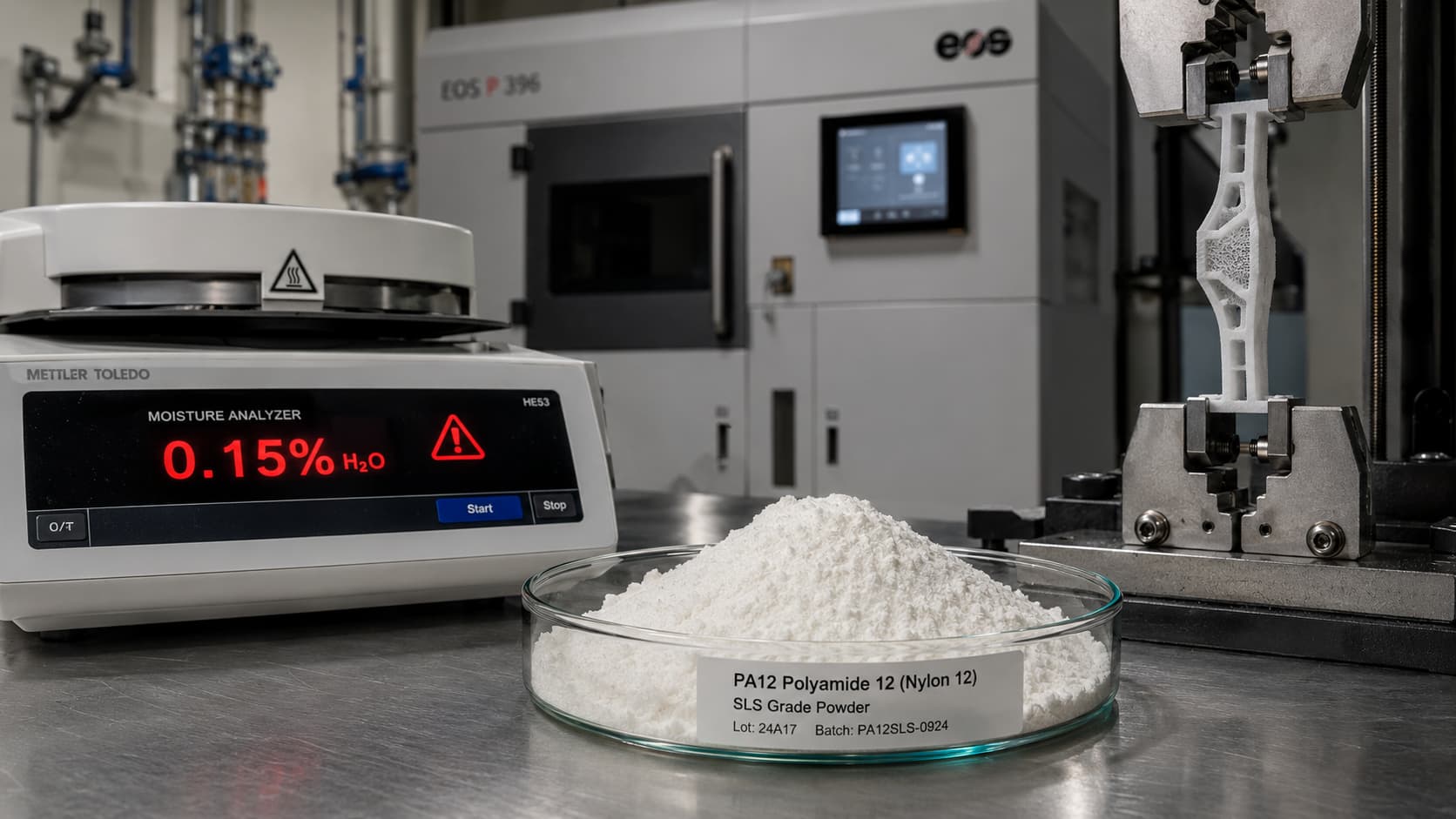
In industrial-grade Selective Laser Sintering (SLS) 3D printing technology, Polyamide 12 (PA12) powder has long occupied a core position in high-end manufacturing due to its excellent mechanical properties, dimensional stability, and chemical resistance. However, on actual B2B production floors, a frequently overlooked physical characteristic—hygroscopicity—is becoming a "hidden killer" that erodes product yield and long-term service life. While most engineers focus their attention on explicit parameters such as laser power, layer thickness, or scanning speed, they are unaware that the adsorption of trace moisture inside the powder particles has already locked in the failure fate of the final component at the microscopic level. This hidden hazard is by no means a simple matter of "surface blistering" or "rough printing"; it is a complete vicious chain extending from anomalous melting behavior to the degradation of the material's molecular chains.
In a typical SLS production scenario, when PA12 powder is not strictly protected by temperature and humidity controls and is exposed to ambient air, its terminal carboxyl and amino groups rapidly adsorb water molecules from the air via hydrogen bonding. When these powders containing trace moisture enter the build chamber, which routinely exceeds 170°C, and are scanned by the laser, the instantaneous high temperature causes the moisture to vaporize sharply. During the microsecond-level melting process, the vaporized water cannot escape from the highly viscous melt pool in time, thereby forming a large number of micro-voids and porosities within the solidified microstructure that are difficult to detect with the naked eye. This discontinuity in the microstructure directly destroys the sintering density, leading to a sharp drop in the interlaminar shear strength of the molded part. In actual assembly or load-bearing testing, such components often undergo brittle fracture at stress levels far below the design threshold.
From the deeper logic of materials physics, the impact of water molecules on PA12 goes far beyond physical porosity destruction; more fatal is the hydrolysis reaction under high-temperature environments. The polymer chains of polyamide are connected by amide bonds, which are highly susceptible to reversible hydrolysis reactions in the co-presence of high temperature and moisture, leading to the cleavage of macromolecular chains and a significant reduction in molecular weight. The reaction can be expressed as:
$$-NH-CO- + H_2O \rightleftharpoons -NH_2 + -COOH$$