What Are You Looking For?

Three Solutions for High Gloss Surface Without Strength Loss to Resolve Glass Fiber Bleed-out & Floating Fibers 2
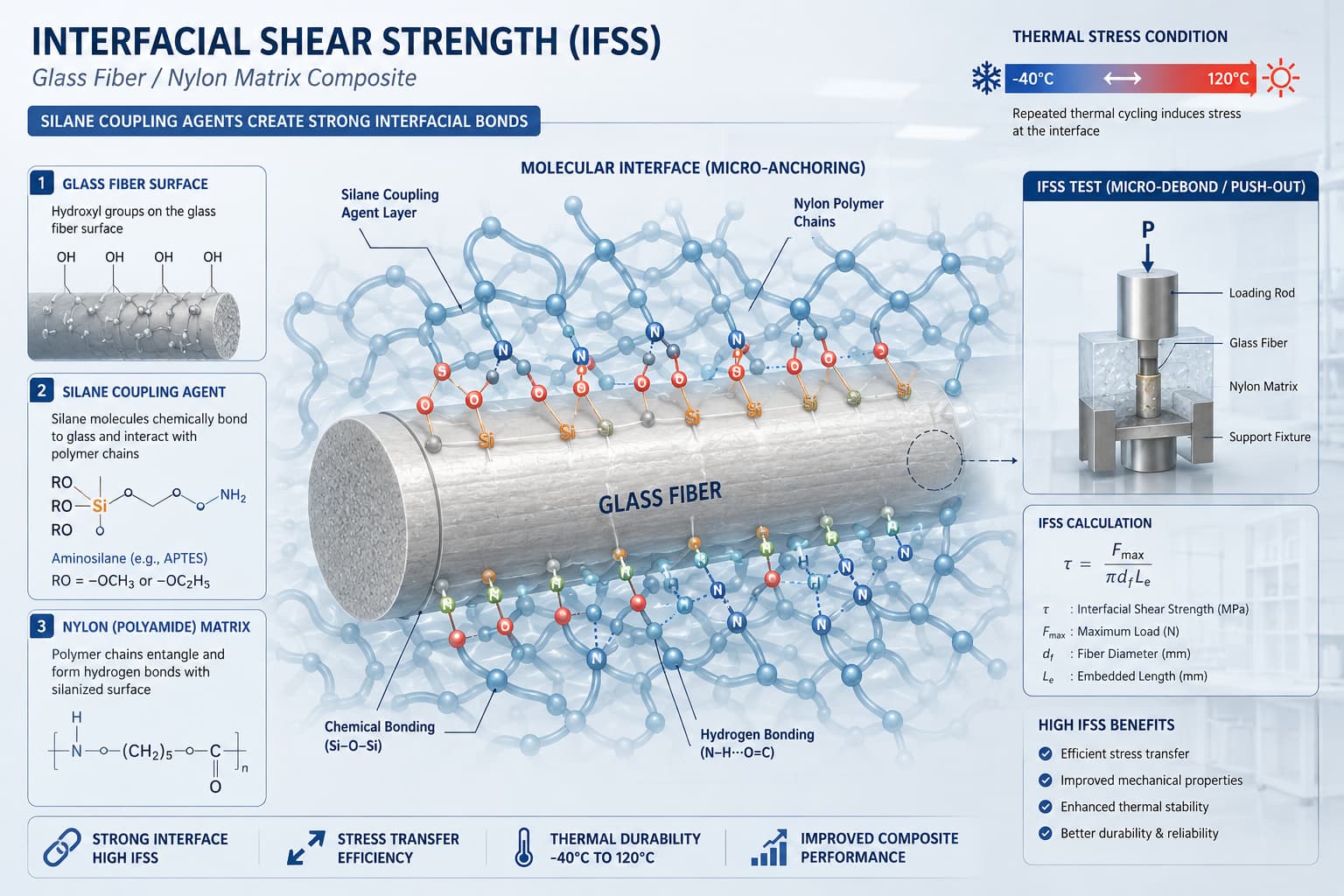
The second pathway addresses "Interfacial Affinities and Chemical Anchoring." Fiber exposure is often exacerbated by interfacial delamination due to localized stress differentials during differential thermal contraction. By utilizing advanced silane coupling agents for secondary fiber-surface sizing, alongside the in-situ blending of high-rigidity, low-molecular-weight toughening segments, a highly resilient interfacial transition zone is established. This methodology optimizes the Interfacial Shear Strength (IFSS). Under high injection pressures, the robust chemical bonds hold the polymer chains rigidly locked onto the fiber geometry, preventing phase separation even under aggressive wall-shear gradients. In automotive structural testing subjected to rigorous thermal cycling (-40°C to 120°C), components engineered with this interfacial anchoring demonstrate zero fiber reflection under intense lighting, while preserving over 92% of their initial flexural modulus after extended aging.
The third technical path couples physical material dynamics with Rapid Heat Cycle Molding (RHCM). Conventional injection practices keep mold temperatures between 80°C and 100°C, forcing the nylon matrix to solidify instantly upon tool contact and leaving the fibers vulnerable to surface migration. RHCM overrides this by employing superheated steam or high-frequency induction to spike the mold surface temperature above 150°C—surpassing the glass transition temperature ($Tg$) and crystallization front of the polyamide—just prior to injection. The matrix remains in an ultra-fluid state, replicating the micro-texture of the tool perfectly while packing the glass fibers deeply within the component core. Once filling completes, rapid water cooling solidifies the part. This setup neutralizes the skin-layer shear effect. Production data indicates that 50% glass-fiber reinforced polyamide processed via RHCM achieves a specular gloss rating above 85% and eliminates weld lines entirely, while improving tensile strength by roughly 3% due to superior crystalline alignment.
These three technical vectors operate not as isolated solutions, but as an integrated toolkit tailored to cost parameters, tooling capabilities, and specific performance benchmarks of international buyers. By utilizing rheological modification as the base substrate chemistry, adding interfacial anchoring, and adopting thermal management for premium geometries, it is entirely feasible to deliver mirror-like surface gloss while sustaining 30% to 60% fiber-reinforcement loads. This empirical methodology bridges the gap between scientific theory and shop-floor execution, serving as a robust commercial lever in high-end global manufacturing procurement.