What Are You Looking For?

Three Solutions for High Gloss Surface Without Strength Loss to Resolve Glass Fiber Bleed-out & Floating Fibers 1
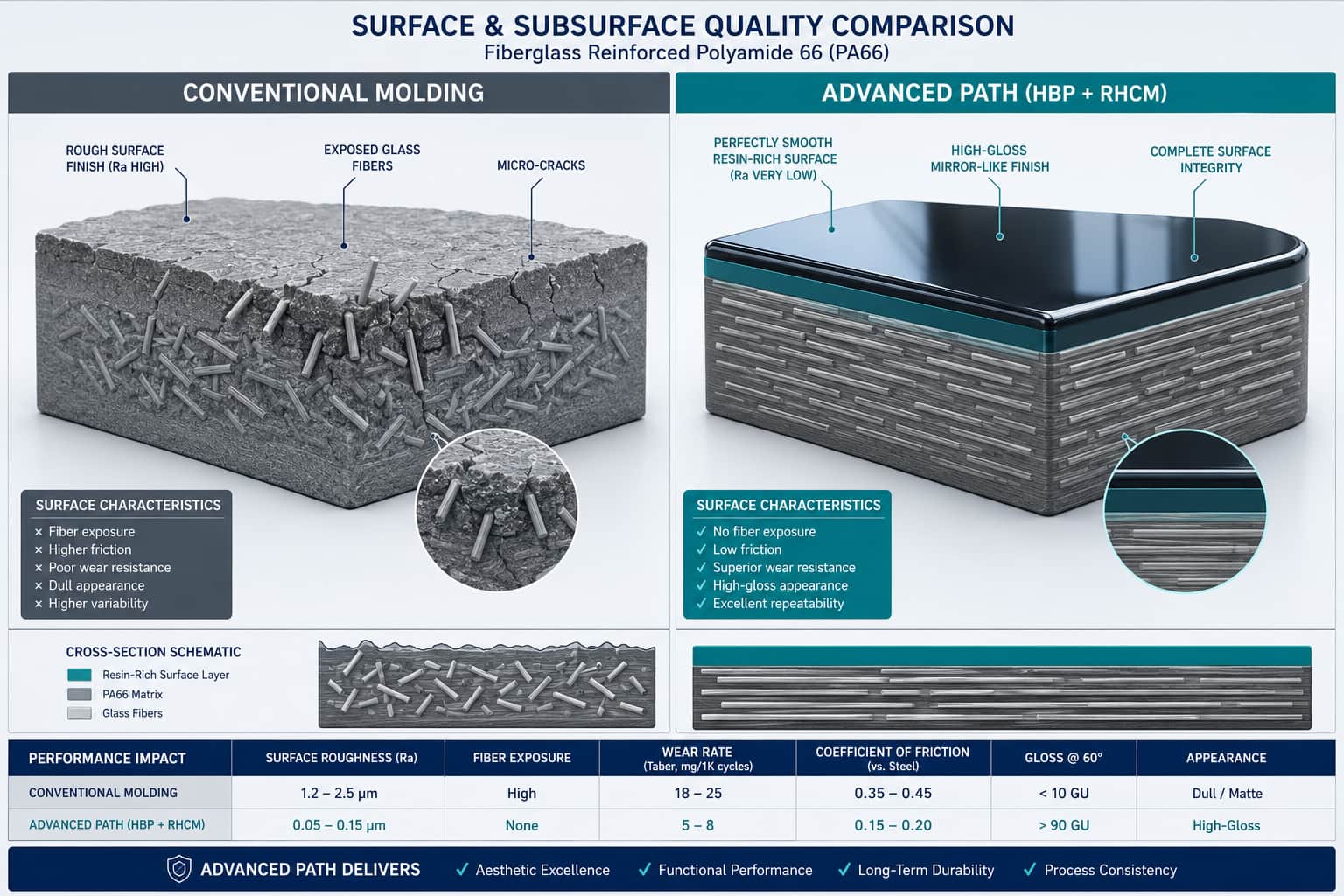
In the sector of engineered plastics, particularly concerning high-percentage glass fiber reinforced polymers used in lightweight structural components, "fiber egress" and surface roughness remain persistent challenges that restrict their integration into high-end consumer electronics, automotive interiors, and precision medical housings. Overseas procurement technical teams frequently encounter samples presenting matte, whitish aesthetics cross-hatched with silver streaks—telltale signs of fiber exposure. A common but flawed response in the processing workshop involves blindly jacking up injection temperatures or overloading standard lubricants. This invariably triggers a catastrophic drop in mechanical properties like impact toughness and tensile modulus, creating a critical credibility gap between suppliers and industrial B2B buyers.
Resolving this requires an investigation into micro-rheology and interfacial thermodynamics. Fiber floating originates from the disparate shear rates, viscosities, and crystallization shrinkage behaviors between the inorganic glass fiber and the organic resin matrix (such as PA6 or PA66) as the melt front advances. Upon entering the mold cavity, the resin rapidly freezes against the cold steel, creating a solidified skin layer. Simultaneously, internal shear forces push the rigid, non-uniform fibers outward. If the polymer matrix cannot wrap around these fibers quickly enough due to inadequate local viscosity or poor wetting, the fibers break through the melt front. Therefore, maintaining premium surface gloss while securing the structural matrix intact requires a calculated synthesis of resin rheology modification, interfacial chemical anchoring, and advanced thermal molding management.
The first pathway dictates "Micro-rheological Equilibrium." Rather than degrading fiber length—which catastrophically shortens the critical fracture wavelength and reduces impact strength—engineering excellence focuses on modifying the molecular weight distribution of the polymer matrix combined with the integration of hyperbranched polymers (HBPs) or reactive rheology modifiers. Introducing specialized hyperbranched structures at fractional percentages drastically diminishes apparent viscosity and the non-Newtonian index within high-shear zones without interrupting the primary macromolecular backbone. This highly fluid melt encapsulates and wets the fibers instantly, constructing a dense, resin-rich lubricating boundary layer along the tool interface. Empirical validations confirm that this configuration drops surface roughness (Ra) from 2.4 $\mu m$ down to below 0.4 $\mu m$, while the terminal functional groups of the HBPs achieve in-situ crosslinking with nylon chain ends, yielding a 5% to 8% uptick in notched impact resistance.