What Are You Looking For?

PA11 vs. PA12 Nylon Powder: How to Choose the Right Material for Your 3D Printing Projects 02
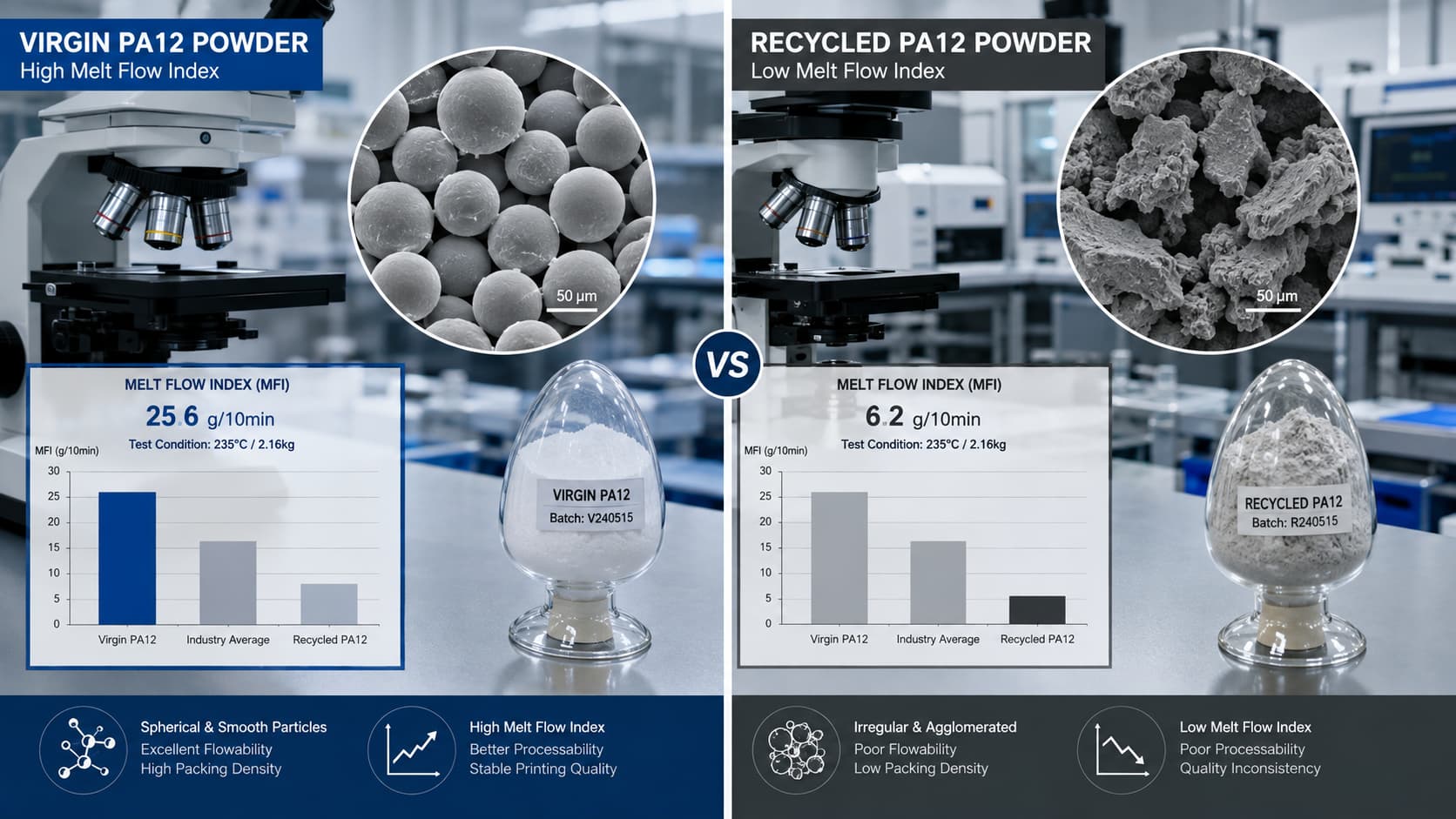
Beyond post-build mechanical characteristics, thermal processing behavior, sintering window stability, and powder reusability dictate per-part production economics for B2B manufacturers. PA12 exhibits a broad and stable thermal processing window, providing a comfortable temperature margin between crystallization and melting points. This thermal cushion minimizes internal stress build-up, simplifies warpage control, and retards thermal degradation of non-sintered powder cake. Empirical production data confirms that PA12 refresh rates can be maintained at 30% to 50%, enabling predictable powder recycling ratios and reducing virgin material replenishment costs. In contrast, PA11 possesses narrower sintering kinetics and higher thermal sensitivity; non-sintered powder degrades faster under prolonged elevated bed temperatures. Managing PA11 requires higher virgin powder refresh ratios (typically 50% to 70%) to prevent surface defects such as orange peel texture or mechanical degradation. R&D teams evaluating unit economics must integrate long-term thermal degradation behavior and scrap rates into total cost-of-ownership models rather than relying solely on raw material unit prices.
Evaluating long-term component reliability requires verifying chemical compatibility and fluid resistance under severe operational environments, such as automotive under-hood compartments, aerospace fluid systems, or chemical processing plants. Owing to its molecular packing, PA11 provides superior barrier properties and lower permeability against hydrocarbon fuels, automotive fluids, hydraulic oils, and polar solvents compared to PA12, demonstrating superior resistance to environmental stress cracking at elevated temperatures. On the other hand, PA12 exhibits superior chemical resistance against strong alkaline solutions and aqueous salt concentrations. Engineering teams should conduct accelerated aging protocols on standardized ISO 527-2 Type 1A test specimens under simulated operating conditions (e.g., 85°C / 85% RH for at least 500 hours) to quantify yield strength retention and impact degradation curves. Establishing empirical verification protocols builds genuine technical trust and ensures end-use parts maintain structural integrity throughout their designed lifecycle.
FAQ
1. What is your MOQ?
For sample orders, we recommend a minimum of 5kg as the MOQ to ensure the validity of the test.
For bulk order, we suggest the minimum quantity is 1000kg, the higher the quantity, the lower the shipping cost.
2、About Sample.
Samples within 5kg are free of charge, shipping cost is not included.
3、About Quality.
We are ISO9001 certified and have perfect testing equipments to ensure that every batch of products are tested and qualified before delivery.
4、About delivery time.
Usually samples can be shipped within 3-5 days, and bulk orders can be shipped within 7-10 days.
5、About transaction and payment method.
We support TT, LC payment method, EXW, FOB, CIF, CNF trading method.