What Are You Looking For?
Weather resistance is a critical performance requirement for nylon materials used in outdoor applications, where long-term exposure to ultraviolet radiation, temperature fluctuations, moisture, and oxygen can progressively degrade material properties. Unlike short-term mechanical testing, outdoor durability is governed by slow and cumulative degradation mechanisms. As a result, relying solely on natural exposure tests is often impractical for product development, making accelerated weathering tests and lifetime prediction models essential tools in polymer engineering.
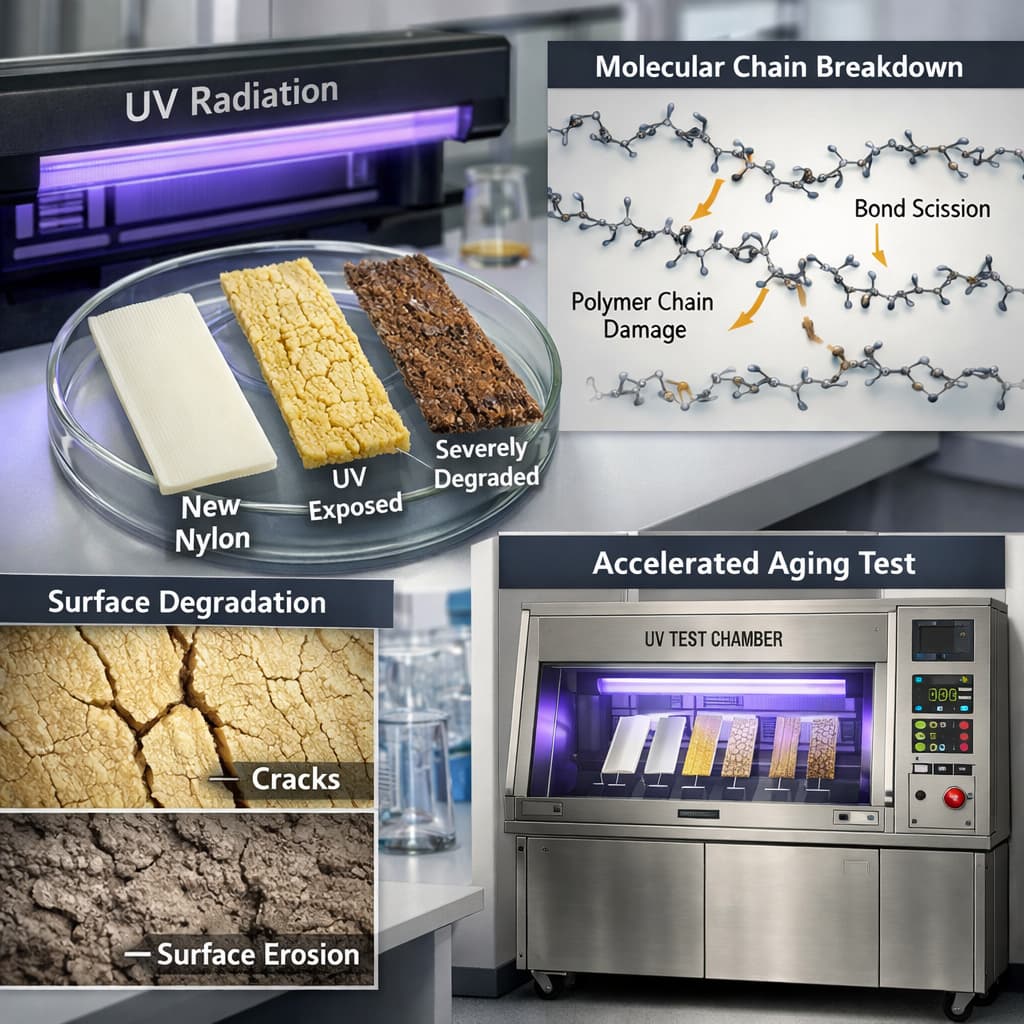
Ultraviolet radiation plays a dominant role in the aging of nylon materials. UV energy can break chemical bonds within the polymer backbone, particularly amide and carbon–carbon bonds, leading to chain scission, molecular weight reduction, and embrittlement. These changes are commonly observed as discoloration, surface chalking, and a significant decrease in impact resistance. Different nylon types exhibit varying sensitivity to UV exposure. For example, PA6 and PA66 generally degrade faster than PA12 or PA612, which benefit from lower moisture absorption and more flexible molecular structures.
To evaluate these effects within a practical timeframe, laboratory-scale accelerated weathering tests are widely used. Xenon arc testing simulates the full solar spectrum and is well suited for assessing color stability and overall property retention, while fluorescent UV testing intensifies specific UV wavelengths to accelerate degradation for comparative studies. These tests are often combined with condensation or water spray cycles to replicate humidity and thermal variations, which are particularly relevant for moisture-sensitive materials such as nylon.
Accelerated aging data alone cannot be directly translated into real-world service life. Instead, it serves as the foundation for aging models that describe the relationship between exposure time and property degradation. Engineers commonly analyze retention curves of tensile strength, elongation at break, or impact resistance to estimate functional lifetime. In more advanced approaches, Arrhenius-based models incorporate temperature dependence into degradation kinetics, improving the reliability of long-term predictions.
Additive systems play a crucial role in enhancing weather resistance. UV absorbers and hindered amine light stabilizers can significantly slow photodegradation, while carbon black and certain mineral fillers provide physical shielding against UV radiation. In fiber-reinforced nylons, although the fibers themselves are not affected by UV exposure, degradation of the polymer–fiber interface can lead to rapid mechanical property loss. Therefore, evaluating the outdoor durability of reinforced nylons requires a holistic assessment of the composite system rather than the base resin alone.
In conclusion, predicting the outdoor lifetime of nylon materials is a multidisciplinary task that integrates material chemistry, accelerated testing, and degradation modeling. When properly designed and interpreted, weathering tests provide valuable insight into long-term performance, enabling informed material selection, formulation optimization, and realistic service-life expectations for outdoor applications.