Factors Affecting the Flowability of Nylon Powder in Additive Manufacturing: An Analysis of Morphology, Particle Size and Moisture Content
Jan 07, 2026
In powder bed fusion additive manufacturing technologies, such as selective laser sintering, the flowability of polyamide powders is a critical factor determining process stability and part quality. Unlike injection molding pellets, powders are continuously subjected to spreading, recycling, and repeated thermal exposure, making their flow behavior especially sensitive.
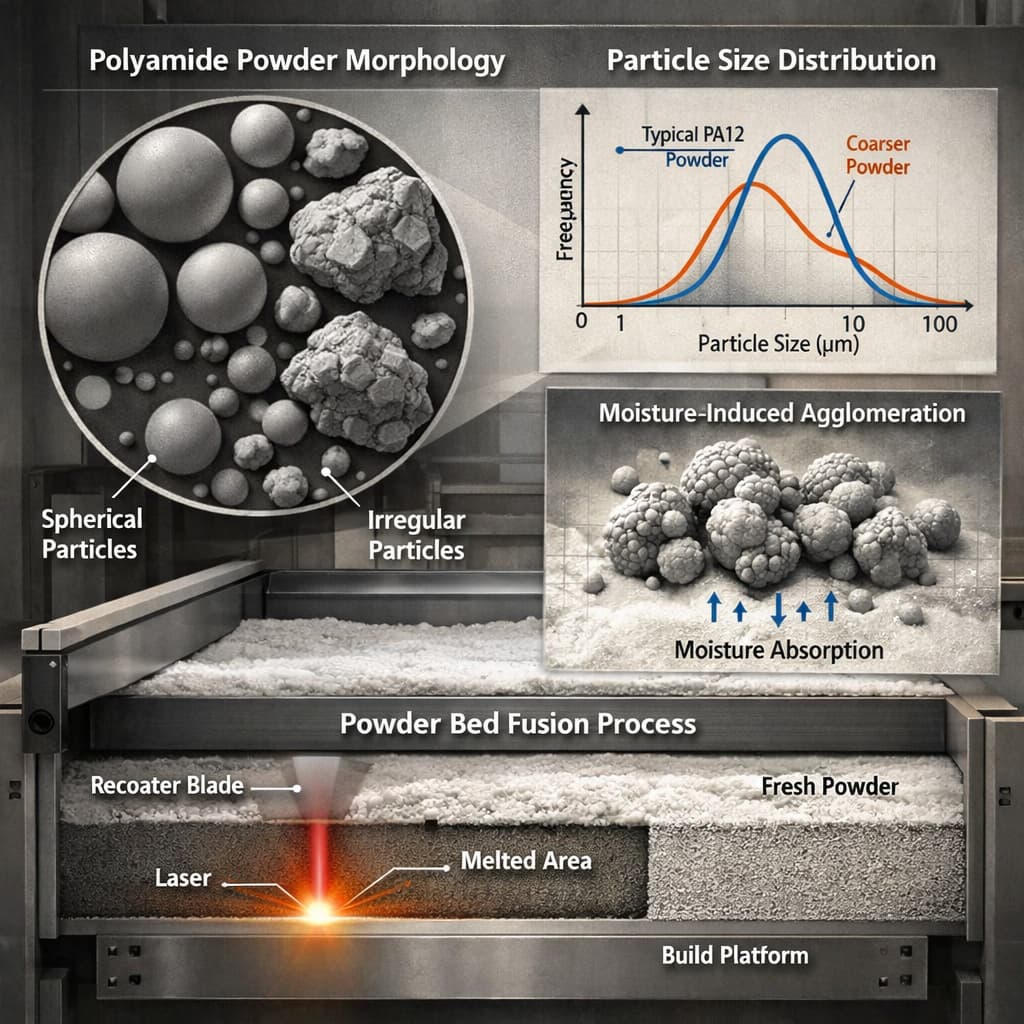
Particle morphology plays a decisive role in powder flowability. Near-spherical particles exhibit reduced interparticle friction and allow for uniform powder layers during recoating. Irregular shapes or satellite particles increase mechanical interlocking, leading to poor layer homogeneity and local defects during printing.
Particle size distribution is equally important. Fine powders offer higher resolution but suffer from increased cohesion due to van der Waals forces and electrostatic interactions. Coarse powders, on the other hand, compromise layer density. Industrial polyamide powders are therefore engineered with narrow distributions, typically centered around 50–70 micrometers.
Moisture content represents a less visible yet highly influential parameter. Polyamides are hygroscopic materials, and even trace amounts of absorbed moisture can form liquid bridges between particles, drastically reducing flowability. This phenomenon is often responsible for unexpected process instability in production environments.
Insufficient powder flowability affects not only powder spreading but also energy absorption, sintering density, and dimensional accuracy. As a result, strict drying protocols, sealed storage systems, and moisture monitoring are standard practices in industrial additive manufacturing. Surface treatments and flow additives are sometimes employed to further enhance powder performance.
Additionally, powder aging through repeated reuse alters surface morphology and thermal behavior, necessitating controlled mixing ratios of virgin and recycled powder. Understanding and managing these variables is essential for achieving consistent and high-quality additive manufacturing outcomes.
Read More