What Are You Looking For?

Proper Use of Recycled Modified Nylon: Mixing Ratio & Performance Compensation Techniques 02
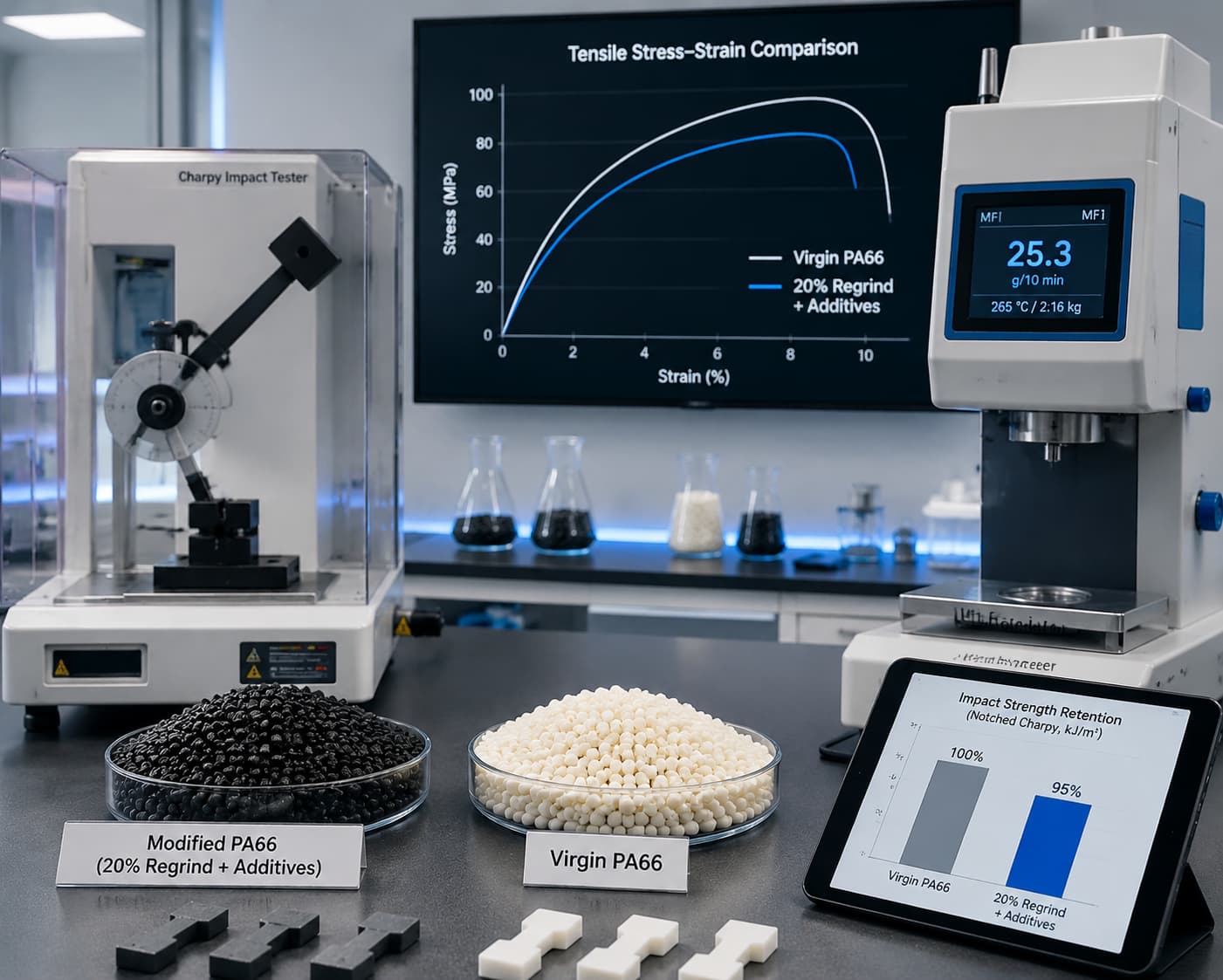
To maintain engineering mechanical properties at higher recycling ratios, molecular chain modification and compatibilization compensation become essential. Addressing chain scission caused by thermal shear and hydrolysis, reactive chain extenders—such as bis-oxazoline or multi-functional epoxy-based compounds—can react rapidly with terminal carboxyl and amino groups of nylon chains. This re-links broken polymer chains, restores high molecular weight, and boosts melt viscosity. Empirical testing demonstrates that adding 0.5%–0.8% highly active chain extender to a PA66+30%GF system containing 20% regrind increases notched impact strength by 15%–22%, noticeably enhances melt strength, and effectively suppresses exposed glass fibers on part surfaces.
In addition to chain extension and reinforcement, antioxidant and anti-thermal aging compensation is critical for ensuring long-term service life. When modified nylon undergoes secondary melting, the primary hindered phenol and secondary phosphite antioxidant package is largely consumed, leaving the polymer highly vulnerable to thermal-oxidative degradation. Replenishing 0.2%–0.4% of a compound antioxidant package combined with micro-amounts of copper-based heat stabilizers captures free radicals generated during processing, halts chain-induced degradation, and prevents rapid deterioration of thermal aging resistance over the component's operational lifecycle.
Finally, constructing a traceable physical property testing and quality control loop is essential for industrial implementation. When purchasing or internally recirculating modified nylon regrinds, manufacturing plants should perform batch testing for density, melt flow rate, ash content (for glass-fiber reinforced grades), and Charpy/Izod notched impact strength. By establishing physical property baselines for various blend ratios and fine-tuning chain extender and stabilizer formulations based on real-time degradation metrics, manufacturers can transform regrind usage from empirical, unrefined blending into a controllable, reproducible, and refined engineering process. This delivers substantial material cost savings while maintaining strict quality standards for sustainable manufacturing.
FAQ
1. What is your MOQ?
For sample orders, we recommend a minimum of 5kg as the MOQ to ensure the validity of the test.
For bulk order, we suggest the minimum quantity is 1000kg, the higher the quantity, the lower the shipping cost.
2、About Sample.
Samples within 5kg are free of charge, shipping cost is not included.
3、About Quality.
We are ISO9001 certified and have perfect testing equipments to ensure that every batch of products are tested and qualified before delivery.
4、About delivery time.
Usually samples can be shipped within 3-5 days, and bulk orders can be shipped within 7-10 days.
5、About transaction and payment method.
We support TT, LC payment method, EXW, FOB, CIF, CNF trading method.