What Are You Looking For?

Proper Use of Recycled Modified Nylon: Mixing Ratio & Performance Compensation Techniques 01
In today's field of injection molding and engineering plastics applications, the proper utilization of modified recycled nylon—such as recycled PA6 and PA66—has evolved far beyond a mere cost-reduction strategy. It has become a core element in supply chain sustainability and carbon footprint management. However, many manufacturing companies frequently encounter abrupt performance drops in practical production. Issues such as a sudden loss of product toughness during continuous molding, insufficient fatigue resistance, brittle failure of structural parts under low temperatures, and severe silver streaks or bubbles caused by hydrolytic degradation are widespread. The root cause is not the inherent non-usability of recycled nylon, but rather a lack of deep understanding regarding the molecular chain degradation mechanisms of polyamide during repeated thermal processing, alongside the absence of precise addition ratio controls and corresponding molecular-level performance compensation techniques.
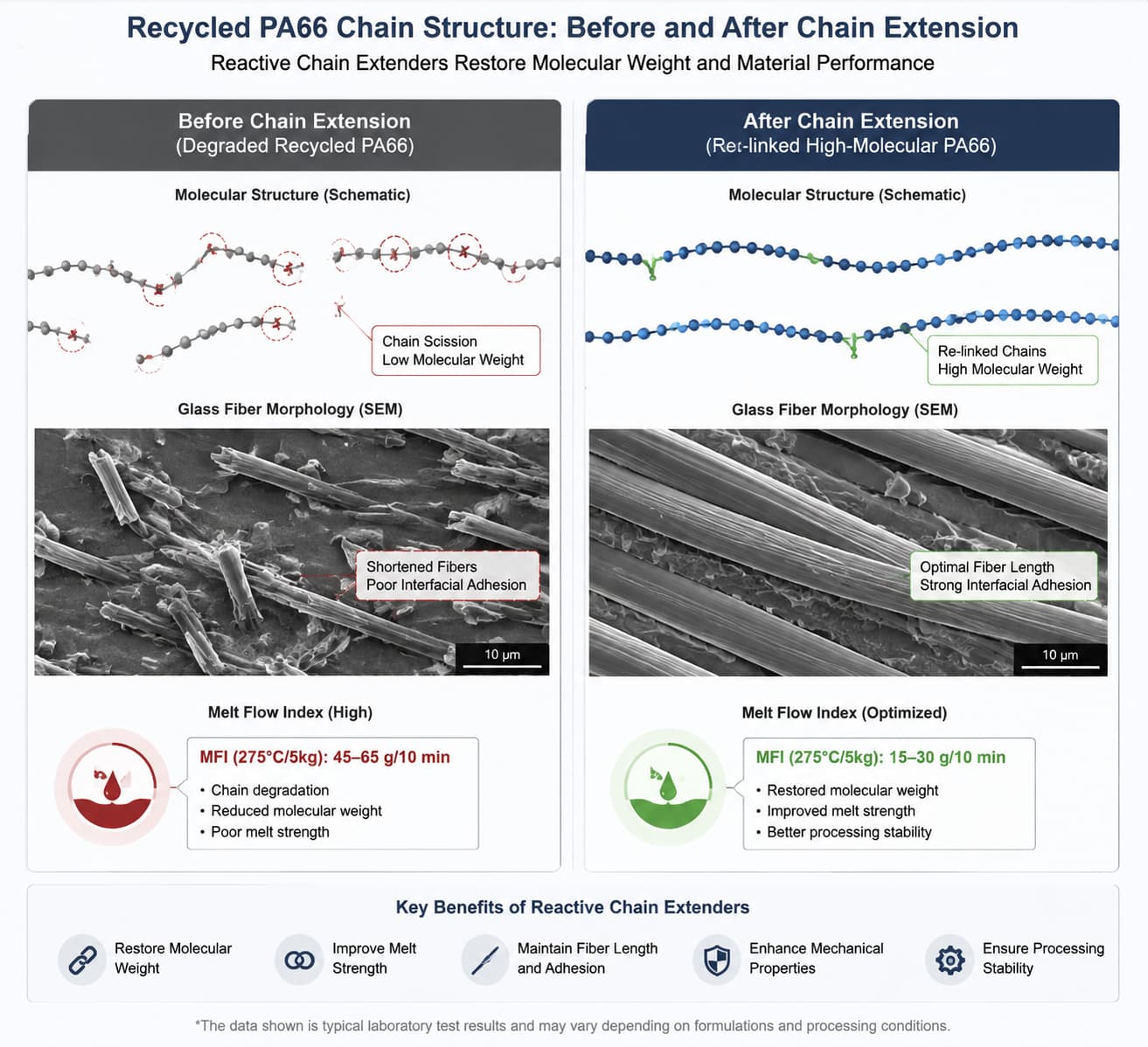
Under real engineering scenarios, nylon resins demonstrate extreme sensitivity to thermal exposure, mechanical shear forces, and residual moisture. During each thermal melting and high-shear passage through an injection molding machine screw, the amide bonds along the polyamide main chain face significant risk of cleavage, leading to reduced molecular weight and a broader molecular weight distribution. For glass-fiber-reinforced modified nylon regrinds, mechanical shear additionally causes severe fiber length degradation, where average glass fiber length can drop from an initial 200–300 microns down to under 100 microns, directly compromising the material's original tensile and impact properties. Directly blending high percentages of recycled material with virgin resin without rigorous pretreatment results in poor surface appearance with exposed fibers, as well as a sharp drop in internal fatigue endurance, seriously damaging product quality stability.
To establish reliable standards for using recycled nylon, the primary prerequisite is a precise understanding of property evolution during re-processing. Thermogravimetric analysis and melt flow rate (MFR) testing reveal that as recycling iterations increase or regrind proportions rise, the MFR increases non-linearly, reflecting molecular chain scission and viscosity loss. Furthermore, recycled granules absorb ambient moisture rapidly during storage. If not subjected to rigorous desiccant drying prior to processing, residual moisture triggers severe hydrolysis under high temperatures, severing polymer chains rapidly. Therefore, establishing a strict pre-drying protocol to maintain moisture content strictly below 0.1% (ideally under 0.05%) inside the hopper serves as the indispensable foundation for any performance compensation method to function.
Regarding addition ratios, engineering experience and empirical data demonstrate that there is no universal "golden ratio." Instead, ratios must be categorized based on the final application requirements, structural load demands, and mold-filling dynamics. For non-structural parts or industrial components with minimal cosmetic standards, regrind proportions can reach 25%–30%, where tensile strength and flexural modulus generally remain around 85%–90% of virgin material levels. However, for precision structural components subjected to dynamic loading, high impact, or high fatigue, the recycled ratio should be strictly capped within 10%–15%. Exceeding 30% regrind content frequently induces a catastrophic decline in elongation at break and notched impact resistance, while melt rheology becomes highly unstable, leading to alternating flash and short shots during injection molding.
FAQ
1. What is your MOQ?
For sample orders, we recommend a minimum of 5kg as the MOQ to ensure the validity of the test.
For bulk order, we suggest the minimum quantity is 1000kg, the higher the quantity, the lower the shipping cost.
2、About Sample.
Samples within 5kg are free of charge, shipping cost is not included.
3、About Quality.
We are ISO9001 certified and have perfect testing equipments to ensure that every batch of products are tested and qualified before delivery.
4、About delivery time.
Usually samples can be shipped within 3-5 days, and bulk orders can be shipped within 7-10 days.
5、About transaction and payment method.
We support TT, LC payment method, EXW, FOB, CIF, CNF trading method.