What Are You Looking For?

Quality Assessment for Modified Nylon Raw Materials: MFR, Ash Content & Mechanical Performance Tests 02
Ash content testing (ISO 3451-1) acts as a direct verification tool for filler loading ratios in reinforced, mineral-filled, or flame-retardant polyamide formulations. Heating samples inside a high-temperature muffle furnace (typically 600°C to 800°C) completely burns away the organic nylon matrix, leaving behind inorganic residues like glass fiber, carbon fiber, talc, or inorganic flame retardants. For glass-reinforced compounds like PA66 GF30, acceptable ash variance must remain within narrow tolerances. An ash reading significantly below spec compromises structural rigidity and Heat Deflection Temperature (HDT). Excess ash increases material density and procurement cost while driving up melt viscosity, accelerating screw wear, and degrading impact toughness. Empirical validation extends further to microscopic inspection of the calcined residue: if residual glass fibers appear crushed into fine powder, the material underwent destructive shear during twin-screw compounding. Even if total ash percentage appears correct, short retention fiber length severely degrades impact strength and fatigue life.
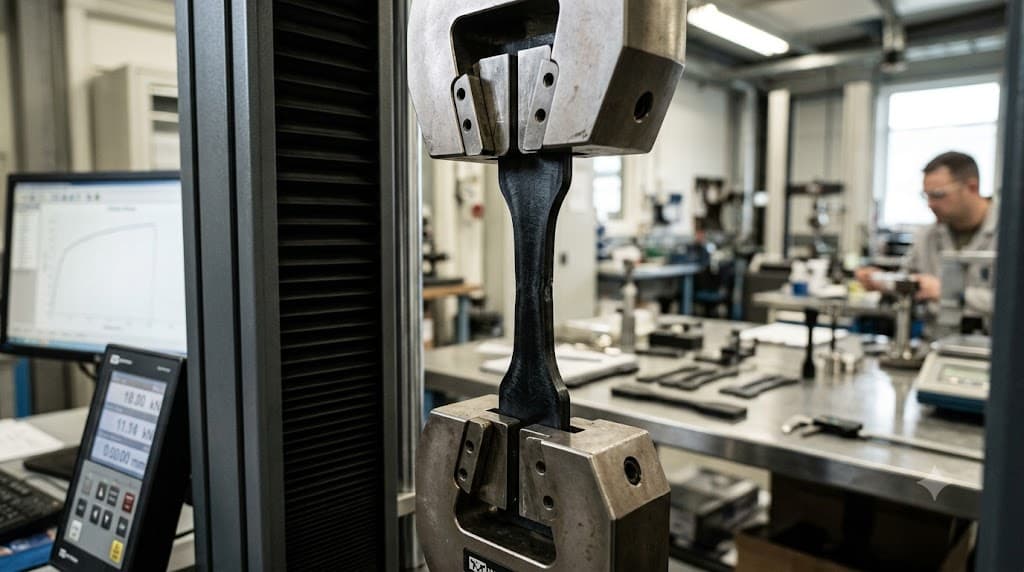
Mechanical performance testing should never rely on static tensile strength alone, but must incorporate comprehensive evaluation across ISO 527 (tensile), ISO 178 (flexural), and ISO 179/180 (impact) standards, explicitly differentiating between Dry-As-Molded (DAM) and moisture-conditioned states. The interfacial adhesion between inorganic fillers and the polyamide matrix determines true mechanical performance. When silane coupling agents fail or disperse unevenly, glass fibers pull out from the matrix under stress rather than transferring tensile loads, leading to dropped elongation at break and sub-standard notched impact resistance. In practical engineering, Izod or Charpy notched impact tests prove exceptionally sensitive at detecting internal stress raisers and poor phase compatibility. For instance, highly flame-retardant nylon grades suffering from small-molecule additive blooming or excessive crystallization exhibit severe drops in notched impact toughness—a hidden defect unnoticeable in standard tensile tests that inevitably leads to brittle snap-fit failure during assembly.
Constructing an effective Incoming Quality Control (IQC) protocol requires combining these three evaluation methods into a closed loop rather than reviewing them in isolation. Upon receiving production samples, inspectors should perform rapid ash testing to verify filler loading and rule out formulation errors. Next, MFR testing under controlled moisture conditions evaluates polymer chain degradation and processing window consistency. Finally, mechanical tensile and notched impact testing on dry specimens validates coupling agent performance and matrix toughness. This three-tier verification process—combining filler verification, molecular chain health check, and destructive mechanical testing—enables international buyers and downstream manufacturers to intercept degraded material, over-sheared glass fibers, or poor interfacial coupling before resins enter the injection molding machine, eliminating batch recalls and building enduring commercial trust grounded in hard engineering data.
FAQ
1. What is your MOQ?
For sample orders, we recommend a minimum of 5kg as the MOQ to ensure the validity of the test.
For bulk order, we suggest the minimum quantity is 1000kg, the higher the quantity, the lower the shipping cost.
2、About Sample.
Samples within 5kg are free of charge, shipping cost is not included.
3、About Quality.
We are ISO9001 certified and have perfect testing equipments to ensure that every batch of products are tested and qualified before delivery.
4、About delivery time.
Usually samples can be shipped within 3-5 days, and bulk orders can be shipped within 7-10 days.
5、About transaction and payment method.
We support TT, LC payment method, EXW, FOB, CIF, CNF trading method.