Size Accuracy Control of Carbon Fiber Reinforced Nylon in 3D Printing: Temperature Field, Shrinkage Rate and Compensation Strategy
Dec 24, 2025
Carbon fiber reinforced nylon has become an increasingly important material in FDM and FFF additive manufacturing due to its high stiffness-to-weight ratio, improved thermal stability, and suitability for functional components. However, dimensional accuracy remains one of the most challenging issues limiting its broader industrial adoption. Compared with unfilled nylon or PLA, carbon fiber nylon exhibits more complex deformation behavior, particularly in medium to large parts, thin-wall geometries, and load-bearing structures. A systematic understanding of this issue requires an integrated analysis of temperature field distribution, material shrinkage mechanisms, and compensation strategies at both software and process levels.
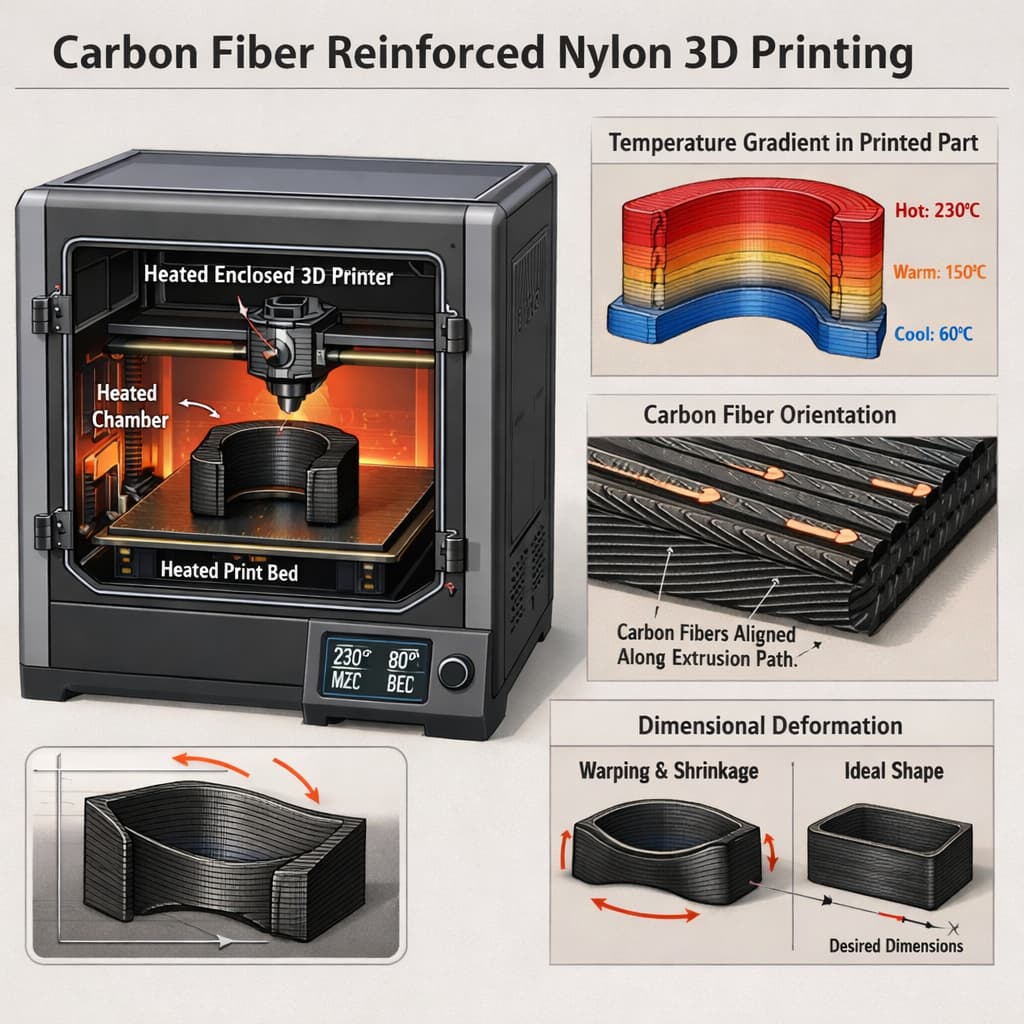
During printing, the temperature field within a part is highly non-uniform and evolves continuously over time. While the molten filament exits the nozzle at temperatures typically ranging from 260 to 320°C, deposited layers cool rapidly toward the glass transition temperature. The introduction of carbon fibers reduces the overall coefficient of thermal expansion but simultaneously increases anisotropy in thermal conductivity and mechanical response. When printing without a controlled heated chamber, temperature gradients between lower and upper layers accumulate, leading to residual stresses, uneven shrinkage, and ultimately dimensional deviation or warping.
From a material perspective, dimensional change in carbon fiber nylon is not governed solely by thermal contraction. It is the combined result of crystallization shrinkage, fiber-induced orientation effects, and stress relaxation during cooling. The nylon matrix undergoes molecular rearrangement as it crystallizes, while carbon fibers constrain shrinkage in a direction-dependent manner. As fibers tend to align along the extrusion path, shrinkage in the X–Y plane is typically lower than in the Z direction. This anisotropic behavior explains why height-related dimensional deviations are often more pronounced, even when overall shrinkage values appear relatively low.
To mitigate these effects, industrial applications rarely rely on material properties alone. Instead, multi-level compensation strategies are adopted. At the hardware level, enclosed heated chambers maintaining ambient temperatures between 60 and 90°C are widely used to reduce interlayer temperature differences. At the process level, optimized print speeds, layer heights, and toolpaths help reduce cooling rates and promote more uniform crystallization. For high-precision components, empirical measurement of directional shrinkage is often followed by non-uniform scaling compensation in slicing software, rather than simple global scaling.
Advanced users increasingly integrate simulation-driven approaches to predict dimensional deviation before printing. Finite element thermal simulations, combined with material-specific thermal and crystallization data, allow engineers to identify regions susceptible to distortion. Although data-intensive, such methods are already proving valuable in aerospace fixtures, automation tooling, and other high-value applications. Ultimately, effective dimensional control requires precise matching between material formulation, process parameters, and compensation models.
All in all, dimensional accuracy in carbon fiber nylon printing is the result of coordinated optimization across material science, thermal management, and digital compensation. Only through a deep understanding of temperature field evolution and shrinkage behavior can additive manufacturing with carbon fiber nylon achieve consistent and predictable engineering performance.
Read More