Our company

carbon fiber nylon

Home

carbon fiber nylon

  • Size Accuracy Control of Carbon Fiber Reinforced Nylon in 3D Printing: Temperature Field, Shrinkage Rate and Compensation Strategy
    Size Accuracy Control of Carbon Fiber Reinforced Nylon in 3D Printing: Temperature Field, Shrinkage Rate and Compensation Strategy
    Dec 24, 2025
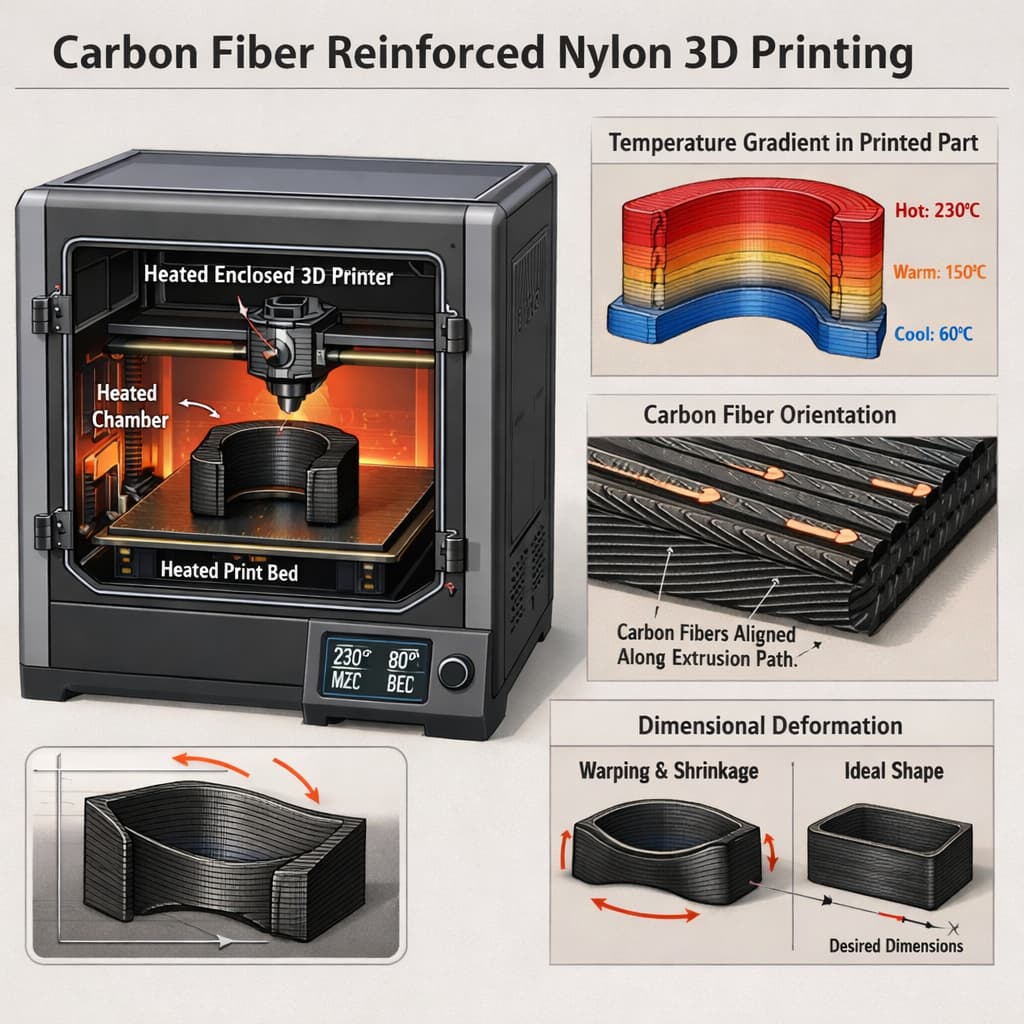
    Carbon fiber reinforced nylon has become an increasingly important material in FDM and FFF additive manufacturing due to its high stiffness-to-weight ratio, improved thermal stability, and suitability for functional components. However, dimensional accuracy remains one of the most challenging issues limiting its broader industrial adoption. Compared with unfilled nylon or PLA, carbon fiber nylon exhibits more complex deformation behavior, particularly in medium to large parts, thin-wall geometries, and load-bearing structures. A systematic understanding of this issue requires an integrated analysis of temperature field distribution, material shrinkage mechanisms, and compensation strategies at both software and process levels. During printing, the temperature field within a part is highly non-uniform and evolves continuously over time. While the molten filament exits the nozzle at temperatures typically ranging from 260 to 320°C, deposited layers cool rapidly toward the glass transition temperature. The introduction of carbon fibers reduces the overall coefficient of thermal expansion but simultaneously increases anisotropy in thermal conductivity and mechanical response. When printing without a controlled heated chamber, temperature gradients between lower and upper layers accumulate, leading to residual stresses, uneven shrinkage, and ultimately dimensional deviation or warping. From a material perspective, dimensional change in carbon fiber nylon is not governed solely by thermal contraction. It is the combined result of crystallization shrinkage, fiber-induced orientation effects, and stress relaxation during cooling. The nylon matrix undergoes molecular rearrangement as it crystallizes, while carbon fibers constrain shrinkage in a direction-dependent manner. As fibers tend to align along the extrusion path, shrinkage in the X–Y plane is typically lower than in the Z direction. This anisotropic behavior explains why height-related dimensional deviations are often more pronounced, even when overall shrinkage values appear relatively low. To mitigate these effects, industrial applications rarely rely on material properties alone. Instead, multi-level compensation strategies are adopted. At the hardware level, enclosed heated chambers maintaining ambient temperatures between 60 and 90°C are widely used to reduce interlayer temperature differences. At the process level, optimized print speeds, layer heights, and toolpaths help reduce cooling rates and promote more uniform crystallization. For high-precision components, empirical measurement of directional shrinkage is often followed by non-uniform scaling compensation in slicing software, rather than simple global scaling. Advanced users increasingly integrate simulation-driven approaches to predict dimensional deviation before printing. Finite element thermal simulations, combined with material-specific thermal and crystallization data, allow engineers to identify regions susceptible to distortion. Although data-intensive, such methods are already proving valuable in aerospace fixtures, automation tooling, and other high-value applications. Ultimately, effective dimensional control requires precise matching between material formulation, process parameters, and compensation models. All in all, dimensional accuracy in carbon fiber nylon printing is the result of coordinated optimization across material science, thermal management, and digital compensation. Only through a deep understanding of temperature field evolution and shrinkage behavior can additive manufacturing with carbon fiber nylon achieve consistent and predictable engineering performance.
    Read More
  • Comprehensive Explanation of Nylon Reinforcement Technologies
    Comprehensive Explanation of Nylon Reinforcement Technologies
    Aug 15, 2025
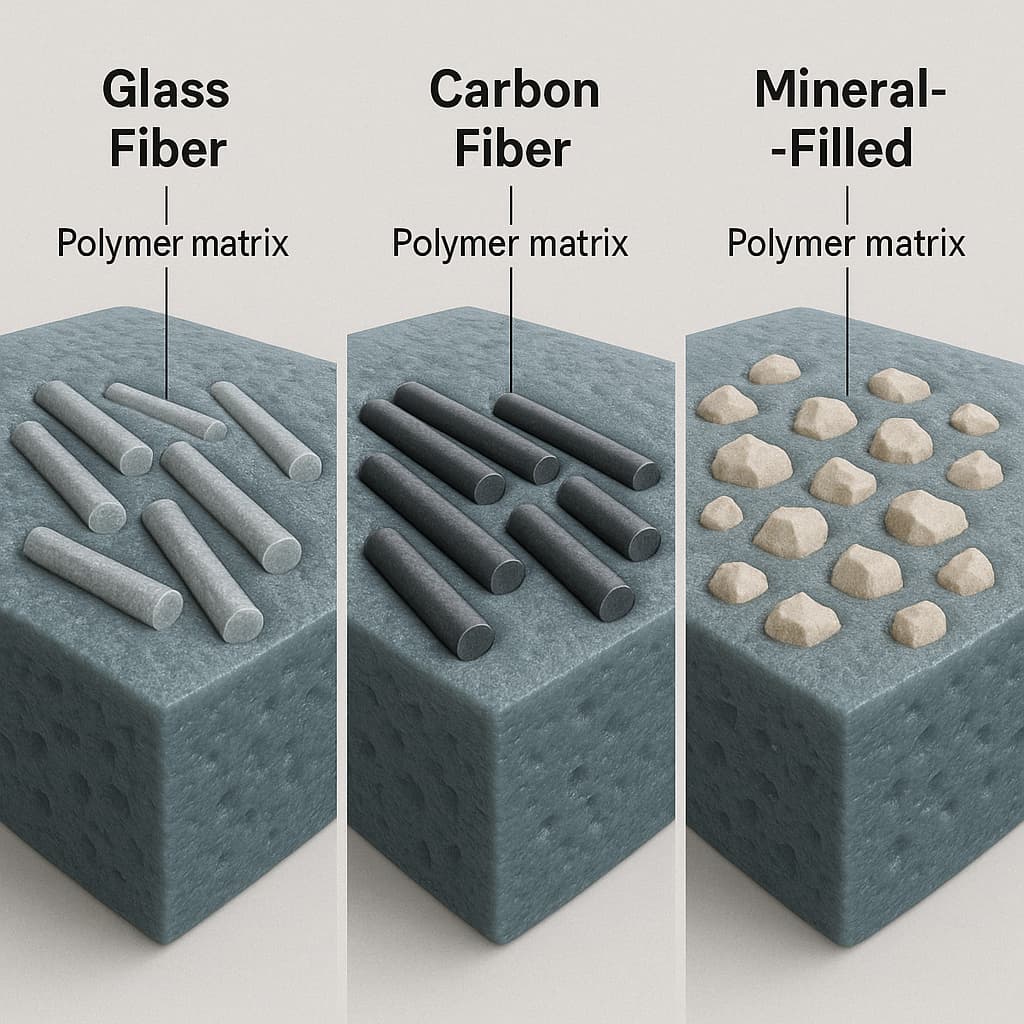
    Nylon reinforcement technology is one of the most important modification methods in the field of engineering plastics. By incorporating different types of reinforcing materials into the nylon matrix, mechanical properties, dimensional stability, and environmental resistance can be significantly improved. Among all reinforcement methods, glass fiber reinforcement, carbon fiber reinforcement, and mineral filling are the three most representative forms, each with unique differences in performance enhancement, processing characteristics, and application scenarios. Glass fiber reinforcement is the most widely used method. Glass fibers offer high strength, high modulus, and good heat resistance. When combined with PA6 or PA66, they significantly improve tensile strength, flexural strength, and heat resistance. The strength of glass fiber-reinforced nylon can be more than doubled compared to virgin material, and it maintains high rigidity even at elevated temperatures. This makes it widely used in automotive engine compartment components, power tool housings, and mechanical structural parts. However, the addition of glass fibers reduces surface smoothness and increases brittleness, so a balance between appearance and performance must be considered in design. Carbon fiber reinforcement excels in applications where lightweight and high performance are equally important. Carbon fiber has a lower density than glass fiber but higher strength, along with excellent fatigue resistance and dimensional stability. Adding carbon fiber to nylon significantly reduces the coefficient of thermal expansion, making it ideal for parts requiring extreme dimensional accuracy. Moreover, carbon fiber-reinforced nylon has higher electrical conductivity, which is advantageous in anti-static or electromagnetic shielding applications. The downside is the high cost of carbon fiber and increased equipment wear during processing, which limits its use mainly to aerospace, high-end automotive parts, and precision electronics. Mineral filling involves adding inorganic minerals such as talc, kaolin, or mica to improve nylon’s dimensional stability, rigidity, and heat resistance. Unlike fiber reinforcement, mineral filling provides limited strength improvement but offers unique advantages in reducing molding shrinkage and enhancing surface smoothness. Mineral-filled nylon is widely used in home appliance housings, office equipment parts, and industrial products with high aesthetic requirements. Due to the low cost of minerals, this method is also highly competitive in cost control. These three reinforcement methods are not mutually exclusive but are selected or combined according to application needs. For example, in automotive parts, glass fiber reinforcement suits load-bearing structural components, carbon fiber reinforcement is ideal for lightweight and high-strength functional parts, and mineral filling is used for appearance components with high dimensional accuracy. In the future, with the advancement of hybrid reinforcement technology, combining multiple reinforcement materials within a single nylon matrix may achieve comprehensive performance optimization to meet the most demanding industrial applications.
    Read More

Leave a Message

Leave a Message
If you are interested in our products and want to know more details,please leave a message here,we will reply you as soon as we can.
submit

Home

Products

WhatsApp

contact