Our company

high-temperature polyamide

Home

high-temperature polyamide

  • Why Does PA66 Fail More Easily Than PPA in Certain High-Temperature Electrical Applications? Section2
    Why Does PA66 Fail More Easily Than PPA in Certain High-Temperature Electrical Applications? Section2
    Jan 21, 2026
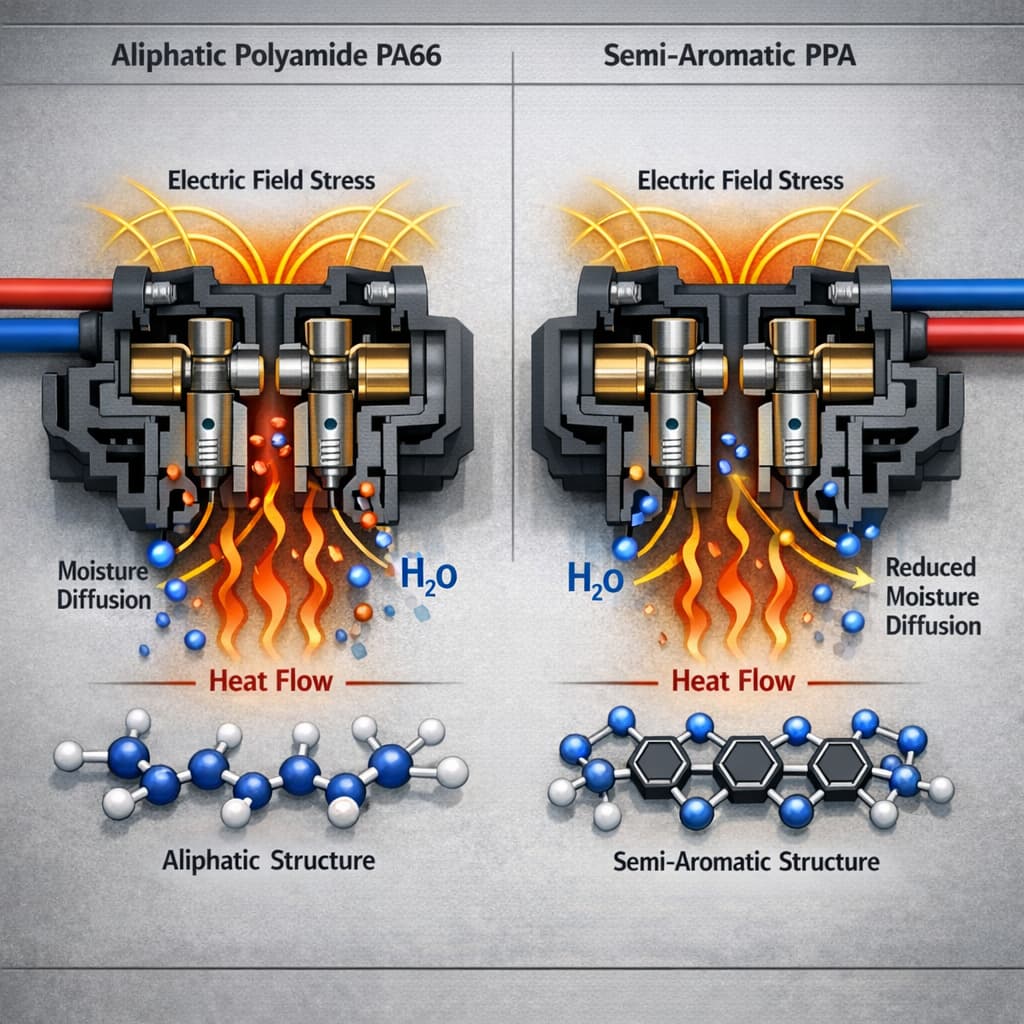
    Moisture absorption is another factor that is frequently underestimated. Even in glass fiber reinforced or flame-retardant grades, PA66 retains a higher equilibrium moisture content than semi-aromatic polyamides. In electrical environments, absorbed moisture does more than cause dimensional change; under an electric field, it contributes to conductive path formation, accelerating the decline in volume resistivity. This explains why PA66 components may perform well in dry-state testing but approach critical limits after hydrothermal aging. PPA behaves differently due to its semi-aromatic molecular structure. The introduction of aromatic rings restricts chain mobility and stabilizes the polymer network at elevated temperatures. As a result, PPA generally exhibits more stable electrical properties during long-term thermal exposure. Its lower moisture absorption further slows performance degradation in humid conditions. Engineering test data reflects this trend. After 1000 hours of aging at 150°C, glass fiber reinforced PA66 often shows a pronounced drop in volume resistivity, sometimes exceeding one order of magnitude. Under comparable reinforcement conditions, PPA compounds typically exhibit more moderate and controllable degradation. Similar tendencies can be observed in CTI performance. This does not imply that PA66 is unsuitable for high-temperature electrical applications. The challenge lies in correctly defining its application limits. When long-term thermal exposure, electrical stress, and high reliability requirements coexist, the safety margin of PA66 becomes narrower. The advantage of PPA lies not in peak performance values, but in its stability over the entire service life.
    Read More
  • Why Does PA66 Fail More Easily Than PPA in Certain High-Temperature Electrical Applications? Section1
    Why Does PA66 Fail More Easily Than PPA in Certain High-Temperature Electrical Applications? Section1
    Jan 21, 2026
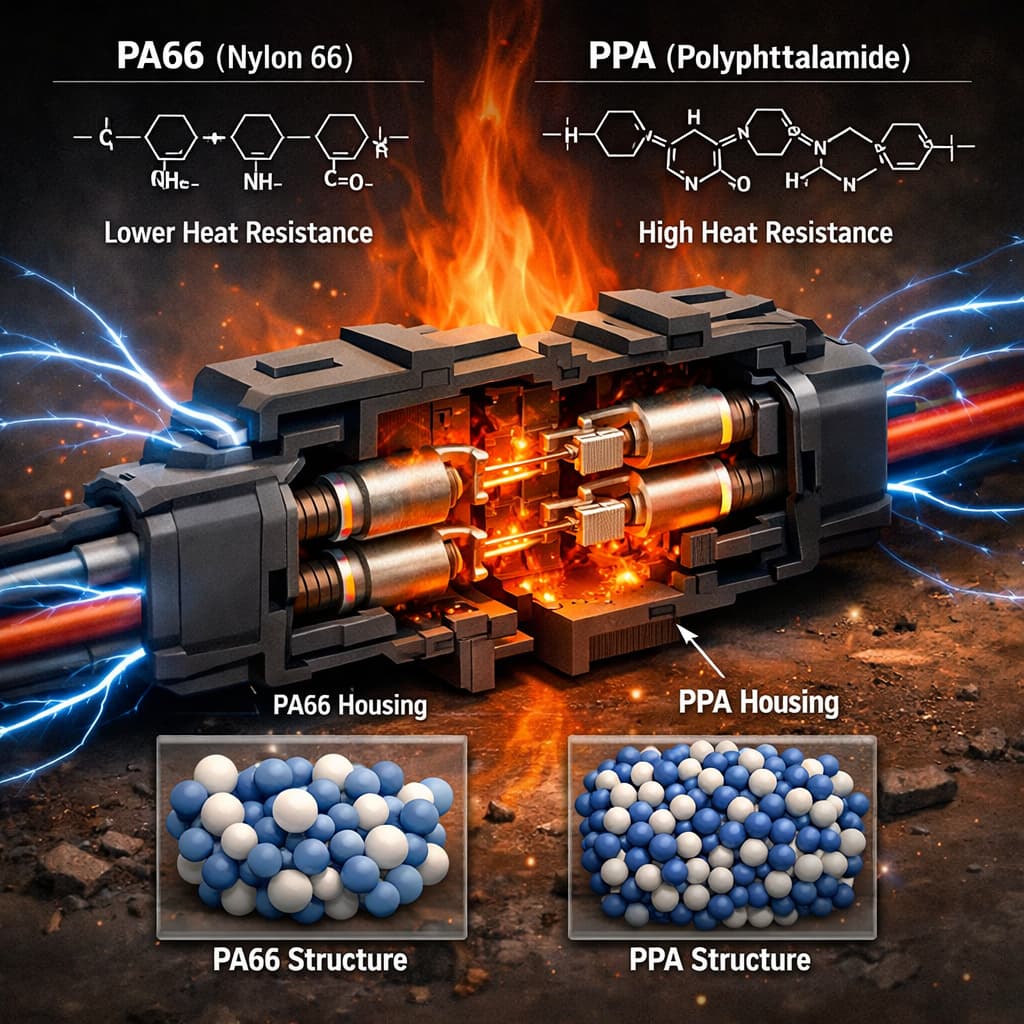
    In high-temperature electrical applications, PA66 has long been regarded as a safe and familiar choice. In many automotive and industrial electrical systems, it is often included in the initial material shortlist simply because its performance range, processing behavior, and supply stability are well understood. This familiarity provides a sense of confidence during early project stages. However, in real-world applications, some failures only become evident after months or years of operation, rather than during prototype validation. In new energy electrical systems, this issue is particularly noticeable. Components may pass qualification tests and initial thermal evaluations without difficulty, yet gradually exhibit insulation degradation, increased leakage risk, or even localized carbonization during long-term service. These failures rarely originate from a single cause; instead, they result from the combined effects of thermal stress, electric fields, and environmental humidity. From an application standpoint, high-temperature electrical components are continuously exposed to multiple stress factors. In electric control modules, operating temperatures of 130–150°C are common, accompanied by thermal cycling and fluctuating humidity. Under such conditions, short-term laboratory data often fails to predict long-term material behavior. The molecular structure of PA66 helps explain this phenomenon. As an aliphatic polyamide, PA66 consists mainly of methylene segments with relatively dispersed amide groups. While this structure provides good toughness and processing flexibility under normal conditions, elevated temperatures significantly increase molecular mobility. As free volume increases, polar group migration becomes easier, which gradually compromises electrical insulation performance.
    Read More

Leave a Message

Leave a Message
If you are interested in our products and want to know more details,please leave a message here,we will reply you as soon as we can.
submit

Home

Products

WhatsApp

contact