Enhancing Barrier Properties of Nylon via Nanofillers: An Analysis of the Latest Material Systems
Jan 07, 2026
Polyamide materials are widely used in engineering applications due to their excellent mechanical strength, wear resistance, and processability. However, their intrinsic permeability to gases and small molecules remains a limiting factor in demanding applications. As industries such as automotive lightweighting, food packaging, chemical fluid transport, and energy systems increasingly require enhanced barrier performance, conventional approaches such as increasing wall thickness or crystallinity are no longer sufficient.
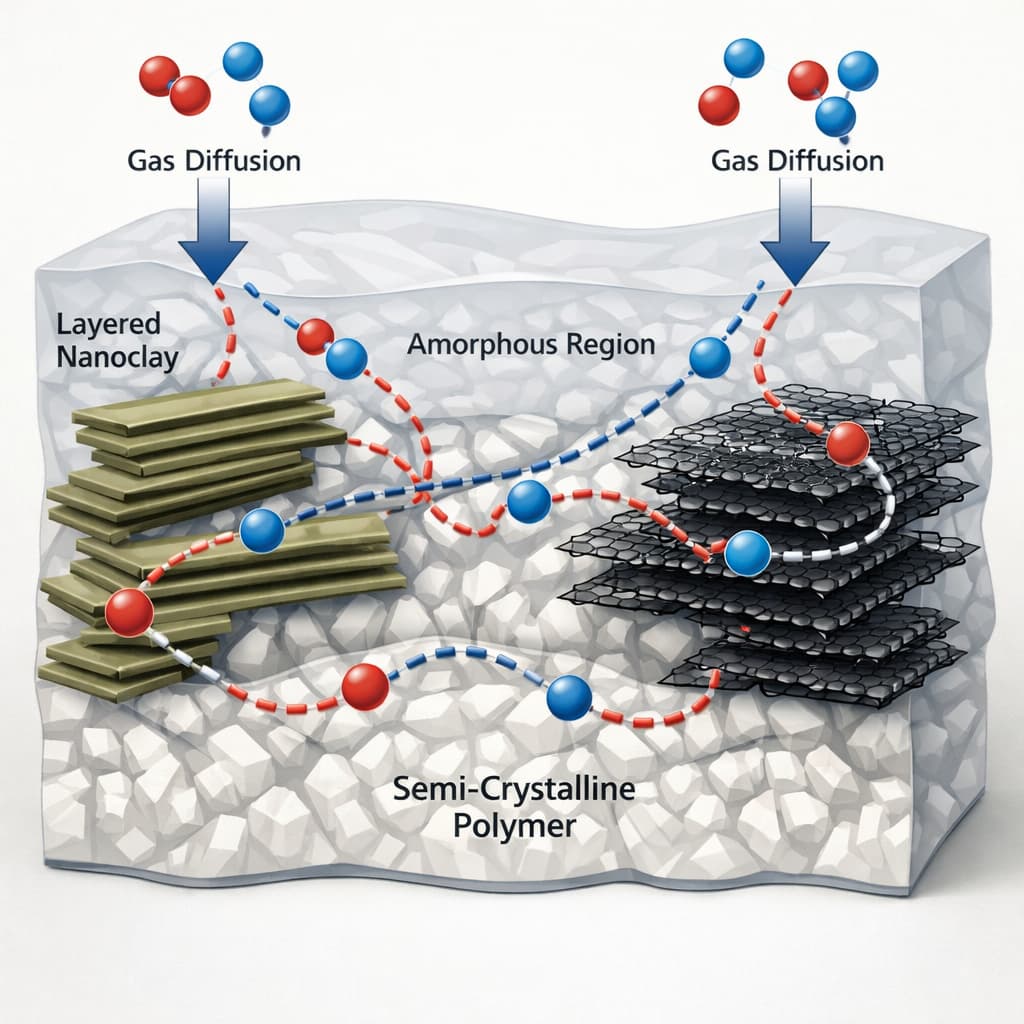
At the molecular level, gas permeation in polyamides is primarily governed by the free volume within the amorphous regions and the mobility of polymer chain segments. The incorporation of nanofillers fundamentally alters the diffusion mechanism by introducing a tortuous pathway. High–aspect ratio nanofillers force permeating molecules to follow longer and more complex diffusion routes, significantly reducing permeability through the so-called labyrinth effect.
Among the most established systems, organically modified nanoclays remain widely studied and industrially applied. When properly exfoliated or intercalated within the polyamide matrix, layered silicates can reduce oxygen and water vapor transmission rates by more than 30% at low loading levels, without severely compromising toughness. Achieving uniform nanoscale dispersion is critical to realizing these benefits.
Graphene and graphene-based fillers have emerged as advanced solutions for high-performance barrier polyamides. Due to their near-impermeable planar structure, even minimal additions can dramatically enhance barrier properties when aligned parallel to the surface. Nevertheless, challenges related to dispersion stability and interfacial compatibility remain key obstacles for large-scale implementation.
Nanofibrous fillers, including cellulose nanofibers and aramid nanofibers, represent another promising route. In addition to extending diffusion paths, these fillers restrict polymer chain mobility through strong interfacial interactions, further reducing free volume. This synergistic mechanism is particularly attractive for bio-based and sustainable polyamide systems.
Modern barrier polyamide design increasingly focuses on low filler loadings combined with multi-scale structural control. By integrating nanofillers with crystallization modifiers, chain extenders, or multilayer processing techniques, manufacturers can balance barrier efficiency, mechanical integrity, and processability. Such approaches are expected to define the future development of nanocomposite barrier polyamides.
Read More