Our company

PPA CF5

Home

PPA CF5

  • How to Avoid Rework Due to EN Standards at the Material Stage for Modified Nylon Projects Exported to Europe? Section1
    How to Avoid Rework Due to EN Standards at the Material Stage for Modified Nylon Projects Exported to Europe? Section1
    Apr 01, 2026
    European engineering plastics projects often focus heavily on pricing, delivery timelines, and processing performance. However, the understanding of European standard systems is frequently postponed until the later stages of project development. In practice, if material compliance with EN standards is not addressed early, repeated testing and material redesign may occur during customer validation. This issue is particularly common for modified nylon materials used in automotive, electrical, and industrial equipment applications. The European market widely relies on the EN standard system for both material and product evaluation. These standards cover multiple aspects including mechanical performance, flame resistance, dimensional stability, and environmental reliability. In electrical applications, for instance, customers may require materials to comply simultaneously with EN 60695 glow-wire testing and EN ISO 527 tensile testing. If materials are not evaluated under these standards during the development stage, additional testing and formulation adjustments may become necessary later. A typical example occurred in an industrial connector project. During early discussions, the customer requested flame-retardant PA66 with UL94 V0 classification. The supplier provided a conventional flame-retardant formulation and completed UL testing. However, during final validation in Europe, additional requirements were introduced, including EN 60695-2-11 glow-wire testing at 750 °C and EN ISO 75 heat deflection temperature testing. The original formulation failed the glow-wire test, forcing the supplier to redesign the flame-retardant system and restart certification procedures. The project timeline was extended by several months. From a material engineering perspective, the main challenge is not the technical complexity but the interpretation of standards. EN standards often emphasize real-world safety conditions. Glow-wire testing simulates overheating scenarios in electrical components, while heat deflection temperature evaluates structural stability at elevated temperatures. Such requirements are rarely reflected directly in conventional datasheets, which means that project teams may overlook them if the standards are not reviewed early.
    Read More
  • Chemical-Resistant Nylon Materials: Application Trends in Industrial Components
    Chemical-Resistant Nylon Materials: Application Trends in Industrial Components
    Oct 23, 2025
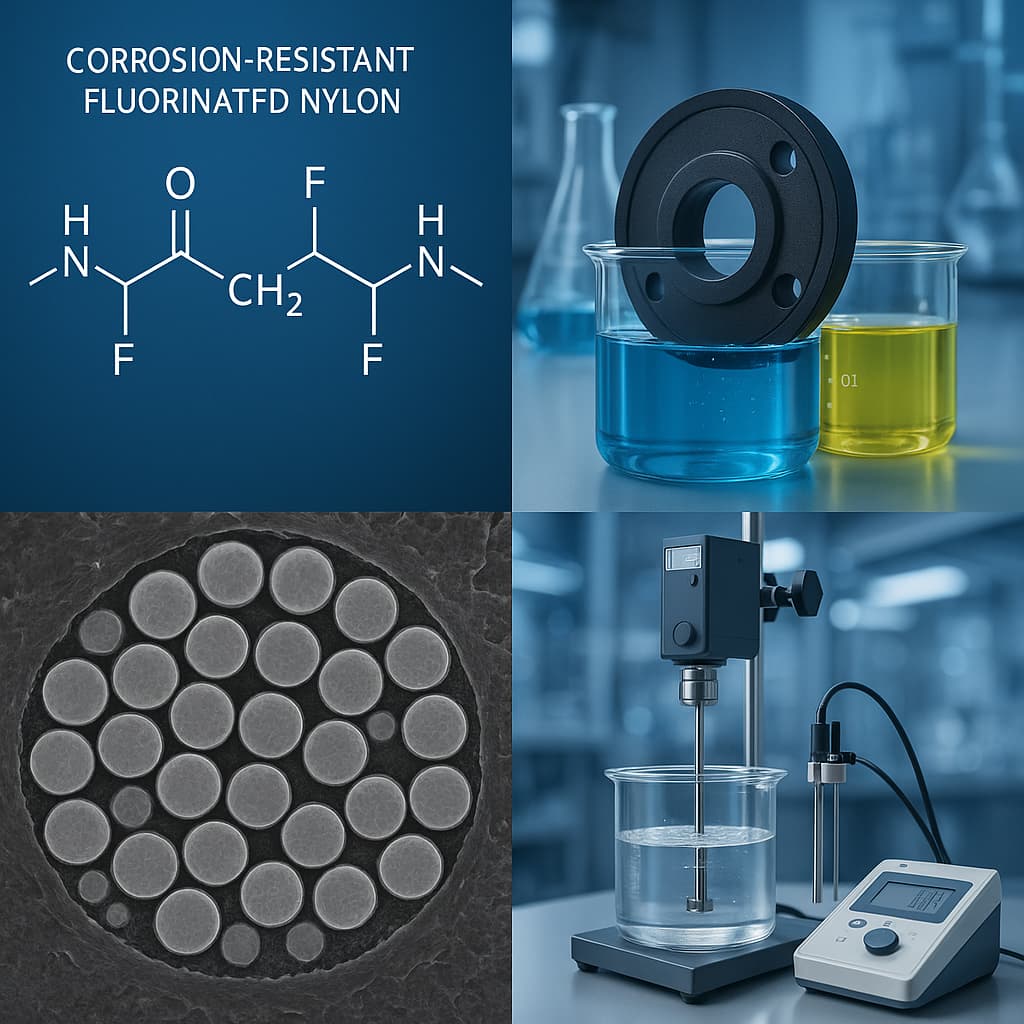
    The development of chemically resistant nylon materials is essential for addressing corrosion challenges in complex industrial environments. Although conventional nylon offers good mechanical and thermal properties, it degrades rapidly in strong acids, alkalis, solvents, and oxidizing agents due to hydrolysis and chain scission. To overcome this limitation, researchers have developed high-performance chemically resistant nylons such as PA6T, PA9T, PPA, and modified PA6/PA66 reinforced with fluorination or composite fillers. The essence of chemical resistance lies in suppressing molecular polarity and reducing hygroscopicity. By introducing aromatic structures or aryl substituents, molecular rigidity is enhanced and hydrogen bond disruption is minimized. Fluorinated groups form a hydrophobic barrier at the molecular level, preventing acid and base penetration. For components exposed to aggressive environments—such as fuel system fittings, chemical pumps, fluid connectors, and EV cooling system parts—these nylons can maintain structural stability for over 5000 hours. During processing, composite reinforcement further enhances performance. Glass fiber, carbon fiber, or mineral fillers reduce water absorption and improve dimensional stability. However, poor interfacial bonding may lead to microchannels for chemical intrusion. Therefore, coupling agents like silanes or fluorinated surface treatments are applied to strengthen the interface, ensuring mechanical integrity and corrosion resistance. With the rapid growth of electric vehicles, chemical processing equipment, and semiconductor manufacturing, the demand for corrosion-resistant polymers continues to rise. Nylon, with its processability and cost-effectiveness, is replacing certain metals and thermoset materials, particularly under moderate to high-temperature chemical conditions. Future research will emphasize multi-layer protective systems, combining bulk and surface resistance through nanocoatings, plasma treatment, and hybrid composites. Environmentally friendly variants with low moisture uptake and recyclability will lead the next stage of industrial nylon development.
    Read More

Leave a Message

Leave a Message
If you are interested in our products and want to know more details,please leave a message here,we will reply you as soon as we can.
submit

Home

Products

WhatsApp

contact